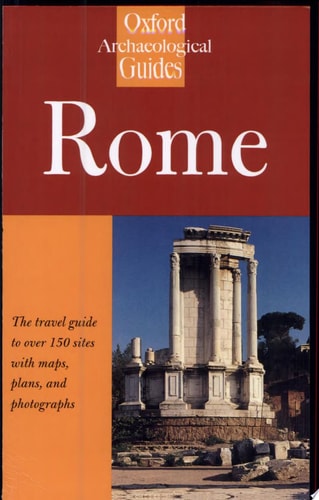
Rome: An Oxford Archaeological Guide
0
0
As an Amazon Associate and affiliate partner, Menrva Books earns from qualifying purchases. Learn more
Author Description
Capital and showcase of the Roman Empire and the center of Christian Europe, the city of Rome is the largest archaeological site in the world. Here, Amanda Claridge presents an indispensable guide to all significant monuments in Rome dating from 800 BC to 600 AD. Included are such breathtaking structures as the Capitoline Hill, the Roman Forum, the Colosseum, the Mausoleums of Augustus and Hadrian, the Circus Maximus, and the Catacombs.Divided into twelve main archaeological areas in central Rome, and four in Greater Rome, this accessible guide provides a detailed overview of the sites, as well as historical reference tables listing archaeological periods, emperors, and principal surviving buildings. The introduction offers an assessment of Roman achievement along with its status as the capital of the Roman Empire, and explains Rome's survival as the world's most complex archaeological site.
Menrva's Summary
THE THESIS
This guide investigates the physical remains of Rome to explain how the city functions as the world's most complex archaeological site. Amanda Claridge, an expert in Roman archaeology, utilizes her extensive knowledge of the city's topography and history to provide a structured framework for understanding monuments dating from 800 BC to 600 AD. The text synthesizes historical context with site-specific analysis to assist both scholars and visitors in navigating the layers of the ancient capital.
THE SCOPE MAP
What You Will Find
- Detailed descriptions of major monuments including the Colosseum, Roman Forum, and various mausoleums.
- A geographic organization system divided into twelve central and four greater Roman archaeological areas.
- Reference tables detailing archaeological periods, imperial timelines, and surviving structures.
Scope Limits
- The guide focuses primarily on the period between 800 BC and 600 AD.
- It does not provide comprehensive coverage of post-600 AD medieval or Renaissance architectural developments.
THE AUTHORITY PERSPECTIVE
Experts and academics frequently cite this work as a foundational resource for navigating the archaeological landscape of Rome. Readers often note the high level of detail and the clarity of the historical context provided for each site.
Page Count:
480
Publication Date:
1998-06-25
Publisher:
Oxford University Press, USA
ISBN-10:
0192880039
ISBN-13:
9780192880031
History
Travel
Rome Italy
Rome
Ancient History
Archaeology
Reference
Community Tags
Similar Books