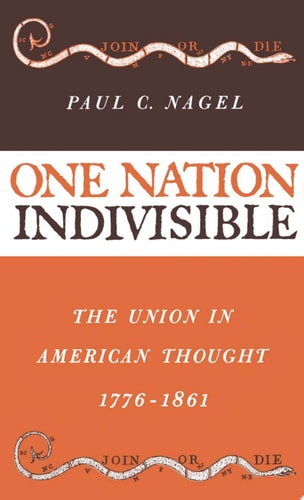
One Nation Indivisible: The Union in American Thought 1776-1861
0
0
As an Amazon Associate and affiliate partner, Menrva Books earns from qualifying purchases. Learn more
Author Description
"The Union" meant meant many things to Americans in the years between the Revolution and the Civil War. Nagel's thesis is that the idea served as a treasure-trove of the values and images by which Americans tried to understand their nature and destiny. By tracing the idea of Union through the crucial, formative years of America's history, he makes clear the nature of the intellectual and emotional responses Americans have had to their country.
Menrva's Summary
THE THESIS
How did the concept of the Union function as a central pillar of American identity and political thought between 1776 and 1861? Paul C. Nagel, a historian specializing in American cultural and intellectual history, examines the evolving definition of the Union during the nation's formative decades. He argues that the Union was not merely a political structure but a symbolic repository for the values, anxieties, and aspirations that defined the American character. By analyzing public discourse, political rhetoric, and private correspondence, Nagel demonstrates how the idea of a unified nation served as a primary lens through which citizens interpreted their collective destiny.
THE SCOPE MAP
What You Will Find
- An analysis of political and social rhetoric from the American Revolution through the onset of the Civil War.
- An examination of the shifting intellectual definitions of national identity and sovereignty.
- A synthesis of primary source documents including speeches, pamphlets, and personal letters.
- A study of the emotional and psychological attachments Americans formed toward the concept of the Union.
THE AUTHORITY PERSPECTIVE
Historians frequently cite this work as a foundational text for understanding the ideological tensions that preceded the American Civil War. Scholars note the clarity of Nagel's prose and his ability to synthesize complex political philosophy into a coherent narrative of national identity.
Page Count:
336
Publication Date:
1964-01-02
Publisher:
Oxford University Press
ISBN-10:
0195000358
ISBN-13:
9780195000351
History
Politics
American History
Intellectual History
New Used & Rental Textbooks
19th Century
Americas
Community Tags
Similar Books