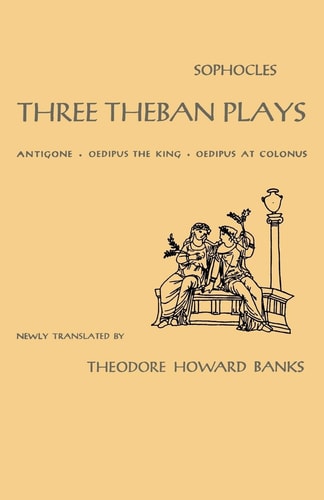
Three Theban Plays: Antigone, Oedipus the King, Oedipus at Colonus
0
0
As an Amazon Associate and affiliate partner, Menrva Books earns from qualifying purchases. Learn more
Author Description
BOOK is a tragedy by Sophocles written in or before 441 BC. It is the third of the three Theban plays but was the first written, chronologically. The play expands on the Theban legend that predated it and picks up where Aeschylus' Seven Against Thebes ends. BOOK TWO Oedipus Rex, also known by its Greek title, Oedipus Tyrannus, or Oedipus the King, is an Athenian tragedy by Sophocles that was first performed around 429 BC.Originally, to the ancient Greeks, the title was simply Oedipus, as it is referred to by Aristotle in the Poetics. It is thought to have been renamed Oedipus Tyrannus to distinguish it from Oedipus at Colonus. In antiquity, the term “tyrant” referred to a ruler, but it did not necessarily have a negative connotation. Of his three Theban plays that have survived, and that deal with the story of Oedipus, Oedipus Rex was the second to be written. However, in terms of the chronology of events that the plays describe, it comes first, followed by Oedipus at Colonus and then Antigone. BOOK Oedipus at Colonus is one of the three Theban plays of the Athenian tragedian Sophocles. It was written shortly before Sophocles' death in 406 BC and produced by his grandson (also called Sophocles) at the Festival of Dionysus in 401 BC. In the timeline of the plays, the events of Oedipus at Colonus occur after Oedipus the King and before Antigone; however, it was the last of Sophocles' three Theban plays to be written. The play describes the end of Oedipus' tragic life. Legends differ as to the site of Oedipus' death; Sophocles set the place at Colonus, a village near Athens and also Sophocles' own birthplace, where the blinded Oedipus has come with his daughters Antigone and Ismene as suppliants of the Erinyes and of Theseus, the king of Athens.
Menrva's Summary
THE PULSE
The central conflict involves the inexorable collision between human agency and divine fate as the house of Oedipus confronts the consequences of forbidden knowledge and moral transgression. The protagonists struggle to reconcile their personal integrity with the catastrophic destinies imposed upon them by the gods. These plays utilize a formal structure characterized by choral odes, dialogue-heavy exchanges, and the dramatic irony inherent in the audience's prior knowledge of the myths. The narrative framework operates through a series of public confrontations that expose hidden truths, forcing characters to navigate the rigid social and religious hierarchies of ancient Thebes and Athens.
INSIDE THE PAGES
- Utilization of the Greek chorus to provide moral commentary and bridge scene transitions
- Employment of dramatic irony to heighten tension as characters remain oblivious to their own fates
- Exploration of the tension between individual conscience and state law
- Focus on the concept of hamartia, or the tragic flaw leading to the protagonist's downfall
- Use of stichomythia, or rapid-fire dialogue, to escalate conflict between characters
- Integration of religious supplication and the role of the gods in human affairs
- Examination of the themes of blindness, sight, and the pursuit of truth
- Structural reliance on the unities of time, place, and action typical of Athenian tragedy
THE COLLECTIVE ECHO
Discussion often centers on the enduring psychological depth of Sophocles' characterizations, particularly the transformation of Oedipus from a confident ruler to a broken exile. Readers frequently highlight the stark contrast between the rigid, authoritarian nature of Creon and the principled, defiant stance of Antigone. Critics often analyze the plays as a meditation on the limits of human knowledge and the inevitable nature of divine retribution. The pacing is noted for its relentless progression toward catastrophe, which maintains intensity through high-stakes verbal debates rather than physical action. These works remain central to the study of Western literature due to their exploration of fundamental human dilemmas.
Page Count:
144
Publication Date:
1956-12-31
Publisher:
Oxford University Press
ISBN-10:
0195010590
ISBN-13:
9780195010596
Drama
Classics
Tragedy
Dramatic works
Plays
Greek Mythology
Community Tags
Similar Books