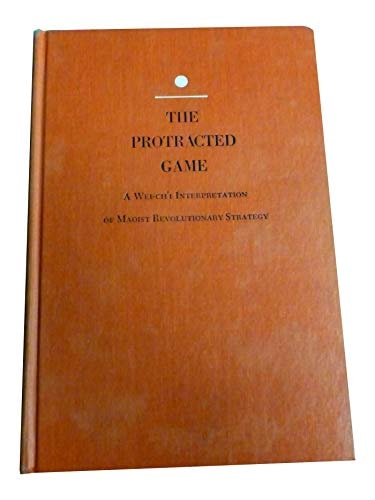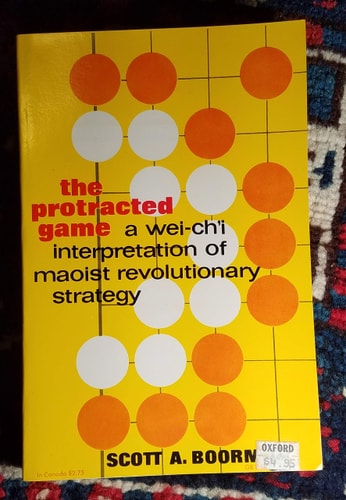
The Protracted Game: A Wei-Ch'i Interpretation of Maoist Revolutionary Strategy
0
0
As an Amazon Associate and affiliate partner, Menrva Books earns from qualifying purchases. Learn more
Author Description
While still a teenager, Boorman wrote The Protracted Game: A Wei-Ch’i Interpretation of Maoist Revolutionary Strategy (1969), an analysis of the U.S. involvement in Vietnam. He shows that the U.S. thought it was playing Chess, while in fact the game was Wei-Ch’i (also known as Go). He systematically explores the similarity between the military strategies of Chinese Communist insurgency and the Chinese board game wei-ch’i, in contrast to parallel U.S. analyses of the same events. Boorman also argues that wei-chi’s analysis of a strategic system presents a more sophisticated and flexible form of game theory than the traditional western models of strategic choice.
Menrva's Summary
THE THESIS
This book investigates the fundamental strategic disconnect between American military doctrine and Maoist revolutionary insurgency during the Vietnam War. Scott A. Boorman, writing as a young scholar, utilizes the framework of the Chinese board game Wei-Ch'i (Go) to critique the limitations of Western game theory. He argues that while the United States approached the conflict through the rigid, decisive-victory lens of Chess, the Maoist forces operated within the fluid, territorial, and long-term strategic logic of Wei-Ch'i.
THE SCOPE MAP
What You Will Find
- A comparative analysis of Chess versus Wei-Ch'i as metaphors for military conflict.
- An application of game theory to the specific tactical maneuvers of the Vietnam War.
- A critique of Western strategic thinking regarding insurgency and revolutionary warfare.
- A detailed exploration of how territorial control and encirclement define Maoist military doctrine.
THE AUTHORITY PERSPECTIVE
Experts frequently cite this work as a seminal text for understanding the cultural and cognitive biases inherent in military strategic planning. Readers often note the academic density of the prose, which remains a foundational study for those interested in the intersection of game theory and geopolitical conflict.
Page Count:
256
Publication Date:
1971-09-15
Publisher:
Oxford University Press
ISBN-10:
0195014936
ISBN-13:
9780195014938
History
Military Strategy
International relations
Politics & Government
Game theory