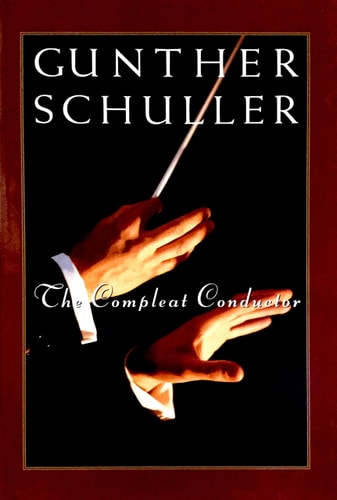
The Compleat Conductor
0
0
As an Amazon Associate and affiliate partner, Menrva Books earns from qualifying purchases. Learn more
Author Description
A world-renowned conductor and composer who has lead most of the major orchestras in North America and Europe, a talented musician who has played under the batons of such luminaries as Toscanini and Walter, and an esteemed arranger, scholar, author, and educator, Gunther Schuller is without doubt a major figure in the music world. Now, in The Compleat Conductor, Schuller has penned a highly provocative critique of modern conducting, one that is certain to stir controversy. Indeed, in these pages he castigates many of this century's most venerated conductors for using the podium to indulge their own interpretive idiosyncrasies rather than devote themselves to reproducing the composer's stated and often painstakingly detailed intentions.Contrary to the average concert-goer's notion (all too often shared by the musicians as well) that conducting is an easily learned skill, Schuller argues here that conducting is "the most demanding, musically all embracing, and complex" task in the field of music performance. Conducting demands profound musical sense, agonizing hours of study, and unbending integrity. Most important, a conductor's overriding concern must be to present a composer's work faithfully and accurately, scrupulously following the score including especially dynamics and tempo markings with utmost respect and care. Alas, Schuller finds, rare is the conductor who faithfully adheres to a composer's wishes. To document this, Schuller painstakingly compares hundreds of performances and recordings with the original scores of eight major compositions: Beethoven's fifth and seventh symphonies, Schumann's second (last movement only), Brahms's first and fourth, Tchaikovsky's sixth, Strauss's "Till Eulenspiegel" and Ravel's "Daphnis et Chloe, Second Suite." Illustrating his points with numerous musical examples, Schuller reveals exactly where conductors have done well and where they have mangled the composer's work. As he does so, he also illuminates the interpretive styl
Menrva's Summary
THE THESIS
This book investigates the core question of whether modern conductors prioritize their own interpretive idiosyncrasies over the precise, documented intentions of the original composers. Gunther Schuller, a distinguished composer and conductor who performed under legendary figures like Toscanini, utilizes his extensive background to argue that conducting is a highly complex, demanding discipline requiring absolute fidelity to the musical score. He posits that the primary duty of a conductor is to serve as a transparent conduit for the composer's specific dynamics, tempo markings, and structural instructions rather than as an independent creative force.
THE SCOPE MAP
What You Will Find
- Comparative analysis of hundreds of recordings against original musical scores.
- Detailed examination of eight major compositions, including works by Beethoven, Brahms, and Tchaikovsky.
- Technical critique of specific conducting errors regarding dynamics and tempo.
- A pedagogical framework defining the ethical and technical responsibilities of the conductor.
THE AUTHORITY PERSPECTIVE
Experts and music scholars recognize this work as a rigorous, albeit polarizing, critique of performance practice that demands high levels of technical literacy. Readers frequently note the academic density of the prose and the uncompromising nature of Schuller's standards for orchestral interpretation.
Page Count:
592
Publication Date:
1997-08-21
Publisher:
Oxford University Press
ISBN-10:
0195063775
ISBN-13:
9780195063776
Music
Music Criticism
Music
Conducting
Humanities
Music theory
Community Tags
Other Editions(3)
Similar Books






Reader Comments
Share Your Thoughts
No comments yet. Be the first to share your thoughts!