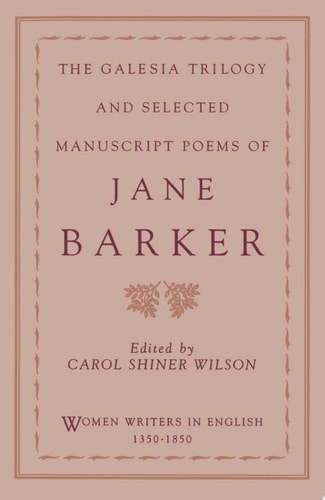
The Galesia Trilogy and Selected Manuscript Poems of Jane Barker
0
0
As an Amazon Associate and affiliate partner, Menrva Books earns from qualifying purchases. Learn more
Author Description
Novelist, poet, manager of farm property, convert to Roman Catholicism, Jacobite in exile in France, and woman unmarried by choice, Jane Barker (1652-1732) wrote on a remarkable variety of subjects and displayed an equally remarkable variety of genres. Her multifaceted work is important in understanding the woman artist, the shifting literary marketplace, and the response of women to a society torn apart by endless wars, religious intolerance, and a legal and economic system that consistently disadvantaged them.Love Intrigues (1713), A Patch-Work Screen for the Ladies (1723) and The Lining of the Patch-Work Screen (1726), the three novels that comprise The Galesia Trilogy, attest to her talents. In all three works, Galesia is Barker's semi- autobiographical narrator and heroine, whose voice becomes like that of a friend to the reader. The first work, an anti-romance celebrated for its psychological realism, captures the confusion and ambivalence of the young Galesia as she is courted by her rakish cousin. The second and third works include a dynamic range of pieces: popular tales of seduced nuns and lust for the high life in London, and more personal poems about Galesia's choice of the artistic life and her practice of the healing arts. Barker brilliantly structures the narratives of the second and third novels as an embroidered patchwork screen, worked harmoniously by a community of women, to which Galesia stitches her artistic productions. This literary conceit, Barker asserts, equals anything developed by her male contemporaries in conveying the truths of human experience. Following the Trilogy, this edition includes several Barker poems, never before published, which prove particularly powerful in capturing life in exile after James II was deposed from the English throne by William of Orange in 1688.This latest addition to the Women Writers in English series will have strong appeal for scholars working in the history of the novel and the literary marketplace.
Menrva's Summary
THE PULSE
The Galesia Trilogy follows the intellectual and personal development of a semi-autobiographical heroine as she navigates the restrictive social and economic landscape of the early 18th century. Through the voice of Galesia, Barker examines the tension between traditional domestic expectations and the pursuit of an independent artistic life. The narrative framework shifts between anti-romance, social commentary, and personal reflection, utilizing a unique patchwork structure to organize disparate tales and poems. Galesia must contend with the pressures of courtship, the instability of political exile, and the limitations placed upon women in the literary marketplace.
INSIDE THE PAGES
- Semi-autobiographical narrative perspective through the character of Galesia
- Anti-romance tropes that subvert traditional courtship expectations
- Patchwork screen narrative conceit used to frame multiple stories
- Integration of prose novels with original manuscript poetry
- Psychological realism in character development and internal monologue
- Exploration of the healing arts and female intellectual autonomy
- Commentary on the Jacobite exile and political instability of the era
- Community-focused storytelling involving a network of female characters
THE COLLECTIVE ECHO
Discussion often centers on Barker's innovative use of the patchwork screen as a structural device to unify diverse narrative threads. Readers frequently highlight the psychological depth of Galesia, noting how her internal conflicts regarding marriage and independence remain relevant to historical studies of the period. Critics emphasize the importance of these works in understanding the shifting literary marketplace and the specific challenges faced by women writers in the 18th century. The inclusion of previously unpublished poems provides a significant resource for those examining the intersection of personal identity and political exile in Barker's life.
Page Count:
384
Publication Date:
1997-03-27
Publisher:
Oxford University Press
ISBN-10:
0195086511
ISBN-13:
9780195086515
Fiction
Poetry
18th century
Historical
classic
Women Writers
Women authors
Community Tags
Other Editions(4)


Similar Books



Reader Comments
Share Your Thoughts
No comments yet. Be the first to share your thoughts!