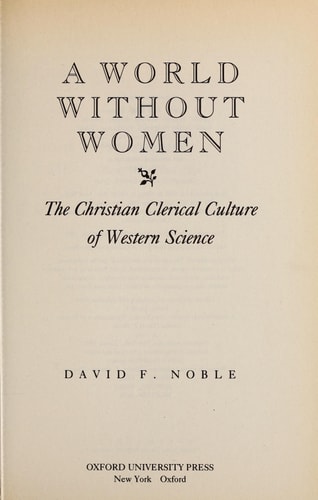
A World Without Women: The Christian Clerical Culture of Western Science
0
0
As an Amazon Associate and affiliate partner, Menrva Books earns from qualifying purchases. Learn more
Author Description
Why is it that Western science evolved as a thoroughly male-dominated enterprise? As philosopher Sandra Harding has noted, "women have been more systematically excluded from doing serious science than performing any other social activity except, perhaps, frontline warfare." In A World Without Women, David F. Noble provides the first full-scale investigation of the origins and implications of the masculine culture of Western science and technology, and in the process offers some surprising revelations.Noble begins by showing that, contrary to the widely held notion that the culture of learning in the West has always excluded women--an assumption that rests largely upon the supposed legacy of ancient Greece--men did not thoroughly dominate intellectual life until the beginning of the second millennium of the Christian era. At this time science and the practices of higher learning became the exclusive province of the newly celibate Christian clergy, whose ascetic culture denied women a place in any scholarly enterprise. By the twelfth century, papal reform movements had all but swept away the material and ideological supports of future female participation in the world of learning; as never before, women were on the outside looking in. Noble further demonstrates that the clerical legacy of a world without women remained more or less intact through the Reformation, and permeated the emergant culture of science.A World Without Women finally points to a dread of women at the core of modern scientific and technological enterprise, as these disciplines work to deprive one-half of humanity of its role in production (as seen in the Industrial Revolution's male appropriation of labor) and reproduction as well (the age-old quest for an artificial womb). It also makes plain the hypocrisy of a community that can honor a female scientist with a bronze bust, as England's Royal Society did for Mary Somerville in the mid-nineteenth century, yet deny her entry to the very meeting hall
Menrva's Summary
THE THESIS
This work investigates the historical origins of the male-dominated culture within Western science and technology, arguing that it is rooted in the exclusionary practices of the medieval Christian clergy. David F. Noble, a historian of technology, examines the transition of intellectual life during the second millennium. He posits that the institutionalization of celibacy among the clergy created an ascetic, male-only environment that systematically barred women from higher learning and scientific inquiry. This clerical legacy, he argues, persisted through the Reformation and continues to influence the gendered dynamics of modern scientific institutions.
THE SCOPE MAP
What You Will Find
- Historical analysis of the transition from inclusive intellectual traditions to the male-dominated clerical culture of the Middle Ages.
- Examination of the impact of papal reform movements on the exclusion of women from scholarly institutions.
- Investigation into the persistence of anti-female bias within the Industrial Revolution and modern technological development.
- Analysis of the ideological and material mechanisms used to maintain male exclusivity in scientific societies.
THE AUTHORITY PERSPECTIVE
Scholars and critics recognize this text as a provocative contribution to the history of science, noting its focus on the intersection of religious institutional history and gender exclusion. Readers frequently highlight the density of the historical research and the author's challenging arguments regarding the persistence of medieval clerical attitudes in contemporary scientific practice.
Page Count:
352
Publication Date:
1993-10-07
Publisher:
Oxford University Press
ISBN-10:
0195084357
ISBN-13:
9780195084351
Philosophy
Science
History
Religion
Sociology
Science europe
Gender Studies
Community Tags
Similar Books