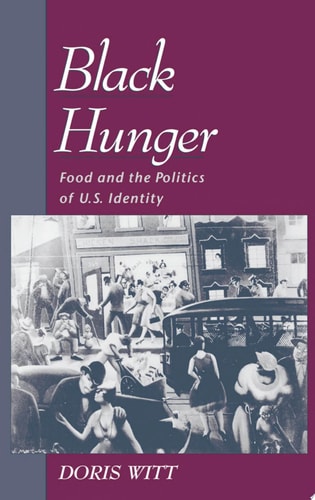
Black Hunger: Food and the Politics of U.S. Identity
0
0
As an Amazon Associate and affiliate partner, Menrva Books earns from qualifying purchases. Learn more
Author Description
The creation of the Aunt Jemima trademark from an 1889 vaudeville performance of a play called "The Emigrant" helped codify a pervasive connection between African American women and food. In Black Hunger, Doris Witt demonstrates how this connection has operated as a central structuring dynamic of twentieth-century U.S. psychic, cultural, sociopolitical, and economic life.Taking as her focus the tumultuous era of the late 1960s and early 1970s, when soul food emerged as a pivotal emblem of white radical chic and black bourgeois authenticity, Witt explores how this interracial celebration of previously stigmatized foods such as chitterlings and watermelon was linked to the contemporaneous vilification of black women as slave mothers. By positioning African American women at the nexus of debates over domestic servants, black culinary history, and white female body politics, Black Hunger demonstrates why the ongoing narrative of white fascination with blackness demands increased attention to the internal dynamics of sexuality, gender, class, and religion in African American culture.Witt draws on recent work in social history and cultural studies to argue for food as an interpretive paradigm which can challenge the privileging of music in scholarship on African American culture, destabilize constrictive disciplinary boundaries in the academy, and enhance our understanding of how individual and collective identities are established.
Menrva's Summary
THE THESIS
This book investigates how the historical association between African American women and food serves as a foundational element in the construction of twentieth-century U.S. identity and sociopolitical life. Doris Witt, an academic specializing in cultural studies, utilizes a multidisciplinary framework to analyze the intersection of race, gender, and class. By examining the evolution of culinary stereotypes and their impact on national discourse, she argues that food functions as a critical interpretive lens for understanding the complexities of American culture.
THE SCOPE MAP
What You Will Find
- Analysis of the Aunt Jemima trademark and its role in codifying racialized culinary stereotypes.
- Examination of the late 1960s and early 1970s as a pivotal era for the cultural commodification of soul food.
- Investigation into the intersection of black culinary history, domestic labor, and white female body politics.
- A methodological argument for prioritizing food studies as a primary site for scholarly inquiry into African American identity.
THE AUTHORITY PERSPECTIVE
Scholars and critics recognize this work as a significant contribution to the field of food studies and African American cultural history. Readers frequently note the academic density of the prose and the author's ability to synthesize complex social history with critical theory.
Page Count:
304
Publication Date:
1999-03-04
Publisher:
Oxford University Press
ISBN-10:
0195110625
ISBN-13:
9780195110623
History
Racism
African Americans
Food Studies
Sociology
Gender Studies