
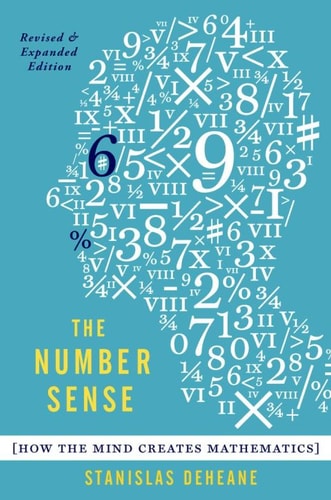
The Number Sense: How the Mind Creates Mathematics
0
0
As an Amazon Associate and affiliate partner, Menrva Books earns from qualifying purchases. Learn more
Author Description
Our understanding of how the human brain performs mathematical calculations is far from complete. But in recent years there have been many exciting scientific discoveries, some aided by new imaging techniques--which allow us for the first time to watch the living mind at work--and others by ingenious experiments conducted by researchers all over the world. There are still perplexing mysteries--how, for instance, do idiot savants perform almost miraculous mathematical feats?--but the picture is growing steadily clearer. In The Number Sense, Stanislas Dehaene offers general readers a first look at these recent stunning discoveries, in an enlightening exploration of the mathematical mind.Dehaene, a mathematician turned cognitive neuropsychologist, begins with the eye-opening discovery that animals--including rats, pigeons, raccoons, and chimpanzees--can perform simple mathematical calculations, and he describes ingenious experiments that show that human infants also have a rudimentary number sense (American scientist Karen Wynn, for instance, using just a few Mickey Mouse toys and a small puppet theater, proved that five-month-old infants already have the ability to add and subtract). Further, Dehaene suggests that this rudimentary number sense is as basic to the way the brain understands the world as our perception of color or of objects in space, and, like these other abilities, our number sense is wired into the brain. But how then did the brain leap from this basic number ability to trigonometry, calculus, and beyond? Dehaene shows that it was the invention of symbolic systems of numerals that started us on the climb to higher mathematics, and in a marvelous chapter he traces the history of numbers, from early times when people indicated a number by pointing to a part of their body (even today, in many societies in New Guinea, the word for six is "wrist"), to early abstract numbers such as Roman numerals (chosen for the ease with which they could be carved into wood).
Menrva's Summary
THE THESIS
This book investigates the biological and evolutionary origins of the human capacity for mathematical thought. Stanislas Dehaene, a cognitive neuropsychologist, synthesizes findings from neuroimaging, animal studies, and developmental psychology to argue that a rudimentary 'number sense' is an innate, hard-wired feature of the human brain. He explores how this biological foundation interacts with cultural symbolic systems to enable the development of complex mathematics.
THE SCOPE MAP
What You Will Find
- Comparative studies on numerical cognition in animals such as rats, pigeons, and chimpanzees.
- Developmental evidence regarding the mathematical abilities of human infants.
- Analysis of the neurological mechanisms involved in basic arithmetic and number processing.
- Historical and anthropological examination of how symbolic numeral systems evolved from body-based counting methods.
THE AUTHORITY PERSPECTIVE
Experts and readers frequently cite this work as a foundational text for understanding the intersection of biology and mathematics. The prose is noted for its accessibility, effectively bridging the gap between complex neuroscientific research and general interest.
Page Count:
288
Publication Date:
1997-11-06
Publisher:
Oxford University Press
ISBN-10:
0195110048
ISBN-13:
9780195110043
Psychology
Science
Philosophy
Politics
Neuroscience
Mathematics
Categories
Cognitive
Counseling Psychology
Kindle Store
Kindle eBooks
Consciousness & Thought
Number Concept
Community Tags
Other Editions(2)
Similar Books







Reader Comments
Share Your Thoughts
No comments yet. Be the first to share your thoughts!