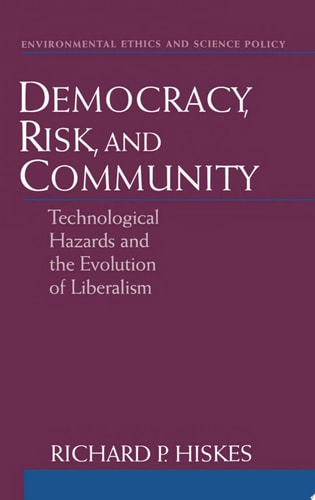
Democracy, Risk, and Community: Technological Hazards and the Evolution of Liberalism
0
0
As an Amazon Associate and affiliate partner, Menrva Books earns from qualifying purchases. Learn more
Author Description
This book presents a novel and compelling thesis about technological risk, liberalism, and policy making in liberal societies. Opposed to most theories of risk that focus on individual decision makers and models or rational choice, this book argues that risks must be seen as intrinsically both emergent and political phenomena. As such, risks resist reduction to individual actors, events, or decisions. To fully understand and make policy for risk, then, it is necessary to recognize that risks call attention to the connections between individuals and events, to the power being exercised in the determination and distribution of risks, and to how the failure to see risks as political, emergent phenomena results in policy failure, as in instances of "Not in My Backyard" (NIMBY) controversies.Liberal societies have particular difficulty in coping with risk, due to the excessively individualistic political theory and epistemology that undergirds liberalism. Thus, seeing risks as emergent has dramatic impact on the fundamental political concepts that make up liberal political theory and operate within liberal societies. The book treats especially the concepts of consent, community, authority, rights, responsibility, identity, and political participation. The meaning of each of these ideas has been altered by modern technological risks, and coping with risk will require that liberal societies redefine what these most basic concepts of political principles are to mean in political practice and policy making.
Menrva's Summary
THE THESIS
This book investigates how the inherent limitations of individualistic liberal political theory hinder the effective management of modern technological risks. Richard P. Hiskes, a scholar of political theory and environmental policy, challenges the prevailing rational choice models that reduce risk to individual decision-making. He argues that technological hazards are emergent, political phenomena that require a fundamental re-evaluation of liberal concepts such as consent, community, and rights to prevent systemic policy failures.
THE SCOPE MAP
What You Will Find
- Analysis of the intersection between liberal political theory and technological risk management.
- Critique of rational choice models and individualistic epistemologies in policy making.
- Examination of political concepts including consent, authority, identity, and responsibility.
- Case study applications regarding NIMBY controversies and the distribution of environmental hazards.
THE AUTHORITY PERSPECTIVE
Experts identify this work as a significant contribution to the intersection of environmental ethics and political philosophy. Readers frequently note the academic density of the prose, which is intended for scholars and policy analysts interested in the evolution of liberal governance.
Page Count:
208
Publication Date:
1998-10-08
Publisher:
Oxford University Press
ISBN-10:
0195120086
ISBN-13:
9780195120080
Philosophy
Technology
Technology and Society
Technology and state
Liberalism
Public Policy