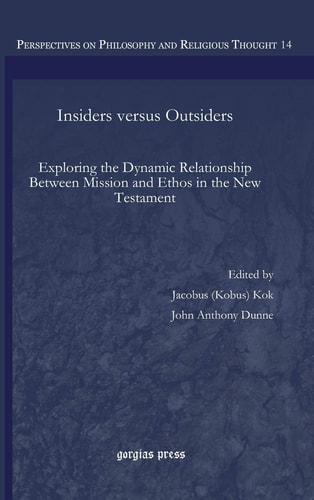
Insiders Versus Outsiders: Exploring the Dynamic Relationship Between Mission and Ethos in the New Testament
0
0
As an Amazon Associate and affiliate partner, Menrva Books earns from qualifying purchases. Learn more
Author Description
In times of conflict and radical change, group identity is often threatened and boundaries need to be renegotiated. The first century was a time of radical change, especially for the Jews. It was in the first century C.E. that the core symbol of Jewish identity, the temple, was destroyed. Social scientists point out that in such turbulent times, groups will often create stronger boundaries around themselves. In such contexts boundaries between insiders and outsiders are created and in ancient texts, expressed in linguistic forms that illustrate such boundaries. Christianity as a movement developed within the already established, but volatile Jewish movement/religion. As a movement Christianity expressed a profound sense of inclusivism and illustrated that value in the transcendence of social boundaries. However, Christianity was also a moral movement, as Wayne Meeks once remarked, and therefore also created boundaries. This is expressed in linguistic expressions, such as to say that the in-group are the pistoi (believers) to be distinguished from the apistoi (the unbelievers). In this book the dynamic reality of creating and transcending boundaries and the relationship between insiders and outsiders are explored by way of reflecting on mission and ethos. Mission is understood as the expansion of early Christianity which was experienced as a (missionary) call or responsibility to share a particular view on God and life. Ethos is understood as the language and behaviour that flowed forth from a missionary understanding of identity. Prof. Jacobus (Kobus) Kok is Associate Professor of New Testament Studies at the University of Pretoria and Doctoral Researcher in Religious Studies at the Radboud University Nijmegen in the Netherlands.
Menrva's Summary
THE THESIS
This book investigates the complex interplay between the expansionist drive of early Christianity and the internal ethical frameworks that defined its identity. The authors, drawing on social scientific insights and linguistic analysis, explore how the nascent Christian movement navigated the turbulent socio-historical landscape of the first century C.E. They examine how Christianity, emerging from a volatile Jewish context marked by the destruction of the Temple, both created strong boundaries to define its 'insiders' (believers) and simultaneously exhibited a profound sense of inclusivism that transcended social divisions. The work posits that mission, understood as the call to share a specific worldview, and ethos, encompassing the language and behavior stemming from that identity, were dynamically related in this process.
THE SCOPE MAP
- Analysis of boundary creation and negotiation in early Christianity.
- Exploration of the concept of 'insiders' (believers) versus 'outsiders' (unbelievers) in the New Testament.
- Examination of linguistic expressions used to delineate group identity.
- Reflection on the destruction of the Temple in the first century C.E. and its impact on group identity.
- Discussion of Christianity's dual nature: inclusivism and boundary creation.
- Definition of 'mission' as the expansion of early Christianity and the sharing of its worldview.
- Definition of 'ethos' as the language and behavior derived from a missionary understanding of identity.
THE AUTHORITY PERSPECTIVE
The book examines the dynamic relationship between mission and ethos in the New Testament, focusing on the creation and transcendence of boundaries between insiders and outsiders. It draws upon social scientific theories and linguistic analysis to understand how early Christianity defined itself within the volatile context of the first century. The work highlights Christianity's dual tendency towards inclusivism and the establishment of distinct group identities, as evidenced in its language and behavior. This scholarly approach offers a nuanced perspective on the foundational development of Christian identity.
Page Count:
297
Publication Date:
2014-01-01
Publisher:
Gorgias Press
ISBN-10:
1463202571
ISBN-13:
9781463202576
Religion
History
Non-Fiction
Religious History
Sociology of Religion
Community Tags
Similar Books