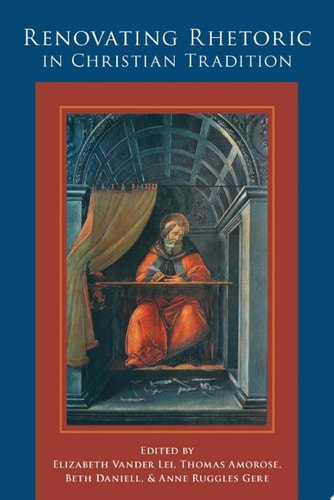
Renovating Rhetoric in Christian Tradition
0
0
As an Amazon Associate and affiliate partner, Menrva Books earns from qualifying purchases. Learn more
Author Description
Throughout history, determined individuals have appropriated and reconstructed rhetorical and religious resources to create effective arguments. In the process, they have remade both themselves and their communities. This edited volume offers notable examples of these reconstructions, ranging from the formation of Christianity to questions about the relationship of religious and academic ways of knowing. The initial chapters explore historic challenges to Christian doctrines and gender roles. Contributors examine Mormon women's campaigns for the recognition of their sect, women's suffrage, and the statehood of Utah; the Seventh-day Adventist challenge to the mainstream designation of Sunday as the Sabbath; a female minister who confronted the gendered tenets of early Methodism and created her own sacred spaces; women who, across three centuries, fashioned an apostolic voice of humble authority rooted in spiritual conversion; and members of the Woman's Foreign Missionary Society of the Methodist Episcopal Church, who redefined notions of women's intellectual capacity and appropriate fields for work from the Civil War through World War II. Considering contemporary learning environments, other contributors explore resources that can help faculty and students of composition and rhetoric consider more fully the relations of religion and academic work. These contributors call upon the work of theologians, philosophers, and biblical scholars to propose strategies for building trust through communication. The final chapters examine the writings of Apostle Paul and his use of Jewish forms of argumentation and provide an overarching discussion of how the Christian tradition has resisted rhetorical renovation, and in the process, missed opportunities to renovate spiritual belief.
Menrva's Summary
THE THESIS
This volume investigates how individuals throughout history have appropriated and reconstructed rhetorical and religious resources to reshape themselves, their communities, and their arguments. The book examines notable examples of these reconstructions, ranging from the formation of Christianity to contemporary discussions on the relationship between religious and academic ways of knowing. The authors, established scholars in rhetoric and religious studies, draw upon historical documents, theological texts, and philosophical arguments to present their findings. Their primary argument is that the dynamic interplay between rhetoric and religion has consistently driven both personal and communal transformation, often in the face of established doctrines and societal norms.
THE SCOPE MAP
- Historical challenges to Christian doctrines and gender roles, including Mormon women's campaigns, the Seventh-day Adventist Sabbath challenge, and early Methodist women ministers.
- Analysis of women's roles in the Woman's Foreign Missionary Society of the Methodist Episcopal Church and their redefinition of intellectual capacity and appropriate work.
- Exploration of contemporary learning environments and resources for composition and rhetoric faculty and students to understand the relationship between religion and academic work.
- Strategies for building trust through communication, drawing on the work of theologians, philosophers, and biblical scholars.
- Examination of the Apostle Paul's writings and his use of Jewish forms of argumentation.
- An overarching discussion on how the Christian tradition has historically resisted rhetorical renovation and the missed opportunities that resulted.
THE AUTHORITY PERSPECTIVE
This collection of essays is likely to be of significant interest to scholars and students in rhetoric, religious studies, and gender studies. The diverse case studies, spanning from early Christianity to contemporary composition classrooms, offer a rich historical and theoretical perspective on the intersection of religious belief and rhetorical practice. The book's strength lies in its detailed examination of how marginalized groups and individuals have strategically employed rhetorical tools to challenge norms and effect change within religious and academic contexts. The concluding chapters provide a critical reflection on the broader implications for the Christian tradition's engagement with rhetorical innovation.
Page Count:
232
Publication Date:
2014-02-28
Publisher:
University of Pittsburgh Press
ISBN-10:
0822979594
ISBN-13:
9780822979593
Religion
History
Non-Fiction
Gender Studies
Rhetoric
Community Tags
Similar Books



Reader Comments
Share Your Thoughts
No comments yet. Be the first to share your thoughts!