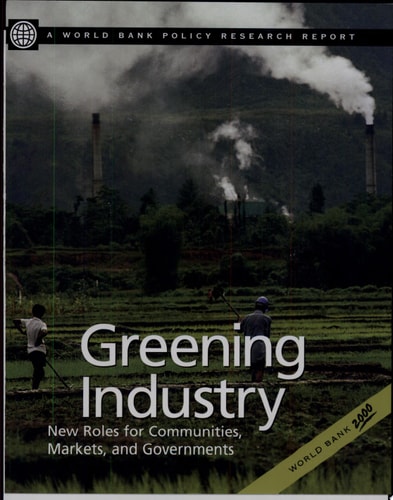
Greening Industry: New Roles for Communities, Markets, and Governments
0
0
As an Amazon Associate and affiliate partner, Menrva Books earns from qualifying purchases. Learn more
Author Description
Greening Industry: New Roles for Communities, Markets, and Governments shows how recent economic and regulatory policy reforms are reducing industrial pollution in developing countries without threatening economic growth.After many failed attempts to import regulatory models from the industrial countries, pioneers of the new approach are developing a new model for environmental control. Based on sound economic principles, this new model incorporates market-based incentives, a broad commitment to public environmental information, and targeted assistance to managers who are trying to improve environmental performance. It stresses participatory regulation where community representatives share in negotiations with government regulators and factory managers. With much better public information about pollution, market agents also make their presence felt through the decisions of consumers, bankers, and stockholders.Greening Industry: New Roles for Communities, Markets, and Governments speaks with authority because its authors helped establish many of the innovative programs that are featured in the report. And the outlook is optimistic. After six years of research, policy experimentation and front-line observation, the authors conclude that sustainable industrial development is within reach. Although greening industry will take time, even the poorest countries can accomplish it. The report shows why, and suggests strategies for moving forward.Greening Industry: New Roles for Communities, Markets, and Governments is an indispensable resource for policymakers, the international development community, students, and all those concerned with protecting the environment.
Menrva's Summary
THE THESIS
This report investigates how developing nations can effectively reduce industrial pollution while maintaining economic growth through innovative regulatory and market-based frameworks. The World Bank authors draw upon six years of research, policy experimentation, and direct observation to challenge traditional, failed regulatory models imported from industrialized nations. They propose a participatory approach that integrates community oversight, market incentives, and transparent information sharing to foster sustainable industrial development.
THE SCOPE MAP
What You Will Find
- Analysis of economic and regulatory policy reforms in developing countries.
- Frameworks for participatory regulation involving communities, government, and factory managers.
- Evidence-based strategies for utilizing market agents like consumers, bankers, and stockholders to influence pollution control.
- Case studies and policy recommendations for achieving sustainable industrial growth in diverse economic contexts.
THE AUTHORITY PERSPECTIVE
Experts recognize this report as a foundational document for understanding the shift toward decentralized environmental management in developing economies. Readers frequently note the technical density of the policy analysis, which serves as a primary resource for development professionals and environmental policymakers.
Page Count:
168
Publication Date:
1999-11-18
Publisher:
Oxford University Press
ISBN-10:
0195211278
ISBN-13:
9780195211276
Economics
Public Policy
Sustainability
Pollution
Community Tags
Similar Books