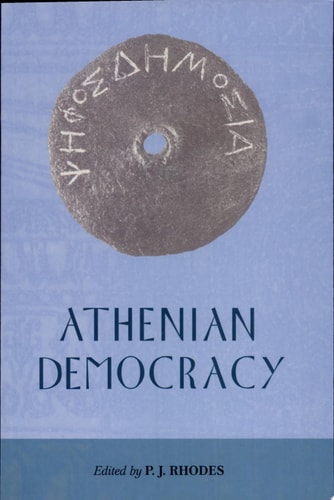
Athenian Democracy
0
0
As an Amazon Associate and affiliate partner, Menrva Books earns from qualifying purchases. Learn more
Author Description
Athens' democracy developed during the sixth and fifth centuries and continued into the fourth; Athens' defeat by Macedon in 322 began a series of alternations between democracy and oligarchy. The democracy was inseparably bound up with the ideals of liberty and equality, the rule of law, and the direct government of the people by the people. Liberty means above all freedom of speech, the right to be heard in the public assembly and the right to speak one's mind in private. Equality meant the equal right of male citizens (perhaps 60,000 in the fifth century, 30,000 in the fourth) to participate in the government of the state and the administration of the law. Disapproved of as a mob rule until the nineteenth century, the institutions of Athenian democracy have become an inspiration for modern democratic politics and political philosophy.P. J. Rhodes's reader focuses on the political institutions, political activity, history, and nature of Athenian democracy and introduces some of the best British, American, German, and French scholarship on its origins, theory, and practice. Part I is devoted to political institutions: citizenship, the assembly, the law-courts, and capital punishment. Part II explores aspects of political activity: the demagogues and their relationship with the assembly, the maneuverings of the politicians, competitive festivals, and the separation of public from private life. Part III looks at three crucial points in the development of the democracy: the reforms of Solon, Cleisthenes, and Ephialtes. Part IV considers what it was in Greek life that led to the development of democracy. Some of the authors adopt broad-brush approaches to major questions; others analyze a particular body of evidence in detail. Use is made of archeology, comparison with other societies, the location of festivals in their civic context, and the need to penetrate behind what the classical Athenians made of their past.
Menrva's Summary
THE THESIS
This volume investigates the structural origins, institutional mechanics, and evolving political theory of Athenian democracy from the sixth century BCE through the Macedonian conquest. P. J. Rhodes, a noted scholar of classical history, compiles a diverse collection of international academic perspectives to examine how the Athenian state balanced the ideals of liberty and equality with the practical administration of law and governance. The text utilizes a multi-disciplinary framework, integrating archaeological findings, comparative sociology, and critical analysis of classical historiography to deconstruct the nature of the Athenian political system.
THE SCOPE MAP
What You Will Find
- Analysis of political institutions including citizenship, the assembly, and the law-courts.
- Examination of political activity, specifically the role of demagogues and the intersection of public and private life.
- Historical case studies on the reforms of Solon, Cleisthenes, and Ephialtes.
- Scholarly synthesis of international research from British, American, German, and French academic traditions.
THE AUTHORITY PERSPECTIVE
Scholars and students of classical history frequently identify this collection as a foundational reader for understanding the complexities of ancient governance. The text is noted for its academic rigor and its ability to present conflicting scholarly interpretations of Athenian political development in a clear, organized manner.
Page Count:
384
Publication Date:
2004-06-03
Publisher:
Oxford University Press
ISBN-10:
0195221400
ISBN-13:
9780195221404
History
Politics & Government
Athens Greece
Government
Ancient History
Democracy history
Community Tags
Other Editions(4)

Similar Books









Reader Comments
Share Your Thoughts
No comments yet. Be the first to share your thoughts!