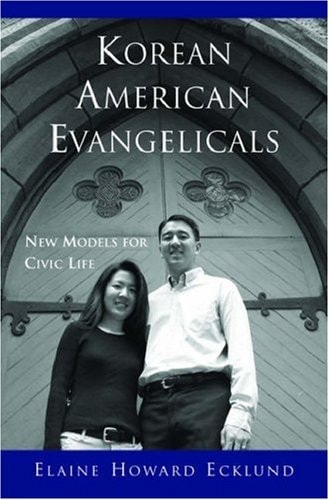
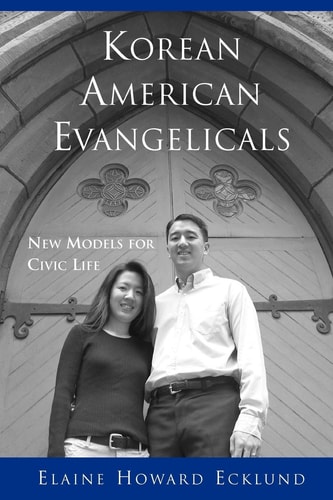
Korean American Evangelicals: New Models for Civic Life
0
0
As an Amazon Associate and affiliate partner, Menrva Books earns from qualifying purchases. Learn more
Author Description
Scholarly and popular commentators lament the deterioration of civil society as a result of American individualism, a decline in some part based on eroding religious participation. In this context, it is important to ask how second-generation immigrants use religious resources to understand, participate in, and potentially change American religion. Scholars stress that religion was vital for the civic integration of earlier European immigrants. However, studies of religion among our nation's newest immigrants largely focus on how religion serves the immigrant community -- for example by creating job networks and helping retain ethnic identity in the second generation. In this book Ecklund widens the inquiry to look at how Korean Americans use religion to negotiate civic responsibility, as well as to create racial and ethnic identity. She compares the views and activities of second generation Korean Americans in two different congregational settings, one ethnically Korean and the other multi-ethnic. Surprisingly, she finds that the Korean churches de-emphasize ethnicity. They look like other evangelical congregations and are concerned about evangelizing in the context of providing social services. Multiethnic churches, in contrast, use evangelical Christianity to legitimate a political and social justice consciousness that values ethnic diversity and and individualized understanding of faith in the context of a conservative Christianity. Korean Americans in both kinds of churches are deeply concerned about helping those in their local community, including non-Koreans and non-Christians. In multiethnic churches, however, Korean Americans also develop an awareness of local politics and a concern with social justice for other ethnic and racial minorities. Ecklund's work is based on ethnographic data from two congregations in one impoverished, primarily non-white city on the east coast, which provided the opportunity to compare how members of each practiced community ser
Menrva's Summary
THE THESIS
How do second-generation Korean American evangelicals utilize their religious frameworks to navigate civic responsibility and construct ethnic identity within the American social landscape? Elaine Howard Ecklund, a sociologist specializing in religion and science, employs ethnographic research to investigate the intersection of faith, ethnicity, and civic participation. By examining two distinct congregational models, she argues that religious settings significantly influence how immigrants engage with broader social justice issues and local political structures. The study challenges existing assumptions about immigrant religious life by highlighting the diverse ways these communities integrate into American civil society.
THE SCOPE MAP
What You Will Find
- Comparative analysis of ethnically Korean versus multi-ethnic evangelical congregations.
- Ethnographic data collected from two specific church sites in an impoverished East Coast city.
- Examination of how religious identity shapes attitudes toward social services and political activism.
- Discussion of the role of evangelicalism in negotiating racial identity and civic integration.
THE AUTHORITY PERSPECTIVE
Experts recognize this work as a significant contribution to the sociology of religion and immigrant studies, particularly for its nuanced look at second-generation experiences. Readers frequently note the academic rigor of the ethnographic approach, which provides a clear framework for understanding the evolving role of religious institutions in American civic life.
Page Count:
222
Publication Date:
2006-11-09
Publisher:
Oxford University Press
ISBN-10:
0195305493
ISBN-13:
9780195305494
Religion
Evangelicalism
Church Work
Sociology
Community Tags
Other Editions(2)
Similar Books









Reader Comments
Share Your Thoughts
No comments yet. Be the first to share your thoughts!