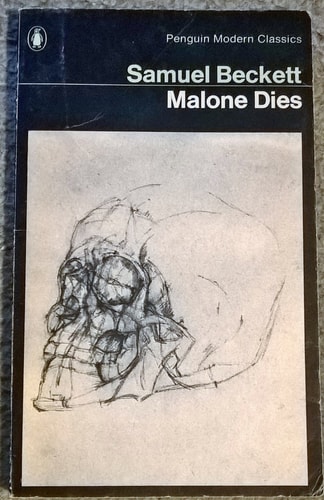
Malone Dies
0
0
As an Amazon Associate and affiliate partner, Menrva Books earns from qualifying purchases. Learn more
Author Description
This is the second in the famous trilogy of novels written by Samuel Beckett in the late 1940s. An old man is dying in a room. His bowl of soup comes, his pots are emptied. He waits to die. And while he waits, he constructs stories, mainly to pass the time. Saposcat, the Lambert family, Macmann and his nurse Moll. Other figures weave in and out of his vision and his imagination. This remarkable soliloquy, so intrinsically Beckettian, is as important as Waiting for Godot or Endgame, the famous plays that made his name.
Menrva's Summary
THE PULSE
Confined to a bed and awaiting his end, an elderly man attempts to stave off the silence of his existence by inventing a series of intricate, shifting narratives. As his physical world shrinks to the dimensions of a single room, the protagonist exerts his remaining agency through the act of storytelling. He populates his isolation with characters like Saposcat and Macmann, whose lives intersect and dissolve within his fading consciousness. The narrative framework functions as a recursive, first-person monologue that blurs the boundary between the creator and his creations. The protagonist faces the logical constraint of his own mortality, which serves as the primary pressure driving his desperate need to generate meaning through fiction.
INSIDE THE PAGES
- First-person stream of consciousness narrative
- Minimalist, stark prose style
- Recursive storytelling structure
- Focus on the act of writing as a survival mechanism
- Blurring of reality and imagination
- Themes of decay, isolation, and existential dread
- Non-linear progression of character arcs
- Absence of traditional plot resolution
THE COLLECTIVE ECHO
Discussion often centers on the radical reduction of narrative form that characterizes this middle volume of Beckett's trilogy. Readers frequently highlight the stark, clinical precision of the prose, which strips away conventional sentimentality to expose the raw mechanics of human consciousness. Critics often note that the book functions as a meta-fictional exploration of the limits of language and the futility of artistic creation in the face of death. The atmosphere is consistently described as claustrophobic yet intellectually rigorous, demanding significant patience from the reader. Many find the interplay between the dying narrator and his invented characters to be a profound meditation on the nature of identity and the passage of time.
Page Count:
144
Publication Date:
1970-03-26
Publisher:
Penguin
ISBN-10:
0140016910
ISBN-13:
9780140016918
Experimental
Philosophical
Classics
Absurdist
classic
British & Irish
Modernist