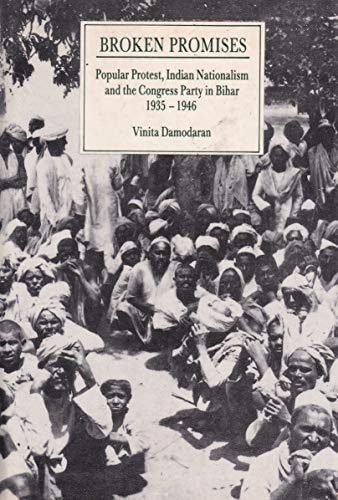
Broken Promises: Popular Protest, Indian Nationalism and the Congress Party in Bihar, 1935-1946
0
0
As an Amazon Associate and affiliate partner, Menrva Books earns from qualifying purchases. Learn more
Author Description
Concentrating on a nine-year period, this study examines the changing relationship between the Congress and its mass base in the penultimate phase of the Raj. This phase of the national movement was particularly important as, in the course of it, the Congress changed from being a movement of opposition to being a party in power. Twice within the period, in 1937-39 and again in 1946, the Congress accepted office. This had far-reaching implications for the nature of the organization and its relationship with its mass constituency. Soon after the Congress assumed office in 1937 a large-scale peasant agitation emerged which aimed to persuade the Congress to abide by its promises to the people and restore peasant rights eroded by landlord attacks and a growing resource crisis. The book highlights the critical ecological context of these agitations. Following the withdrawal from office in 1939, the pressures on the Congress shifted dramatically. This process was to culminate in the Quit India movement in 1942. Immediately after this mass upsurge, the Congress retreated underground and became a more amorphous organization allied to dacoit gangs in the countryside. The activities of these underground organizations, known as the Azad Dastas, have not been described previously, and provide an instructive picture of the nature of popular nationalism.
Menrva's Summary
THE THESIS
How did the transition of the Indian National Congress from an opposition movement to a governing body in Bihar fundamentally alter its relationship with its mass constituency between 1935 and 1946? Vinita Damodaran, a historian specializing in modern Indian history, utilizes extensive archival research and regional primary sources to examine the political evolution of Bihar during the final decade of British rule. The book argues that the Congress party's acceptance of office in 1937 and 1946 created a tension between institutional governance and the radical demands of the peasant base. By analyzing the ecological and socio-economic pressures of the era, the author demonstrates how these shifting loyalties shaped the trajectory of the nationalist movement.
THE SCOPE MAP
What You Will Find
- A detailed analysis of the political transition in Bihar during the 1937-1939 and 1946 Congress ministries.
- Examination of the Azad Dastas and their role as underground nationalist organizations.
- Integration of ecological and resource-crisis data as drivers for peasant agitation.
- Primary source documentation regarding the interaction between landlord interests and peasant rights.
THE AUTHORITY PERSPECTIVE
Academic reviewers frequently cite this work as a rigorously researched monograph that provides a nuanced understanding of regional nationalism. Experts highlight the text as a significant contribution to the study of the Quit India movement and the complexities of grassroots political mobilization in colonial India.
Page Count:
412
Publication Date:
1993-05-27
Publisher:
Oxford University Press
ISBN-10:
0195629795
ISBN-13:
9780195629798
History
Nationalism
Colonialism
Communism india
India
Community Tags
Similar Books