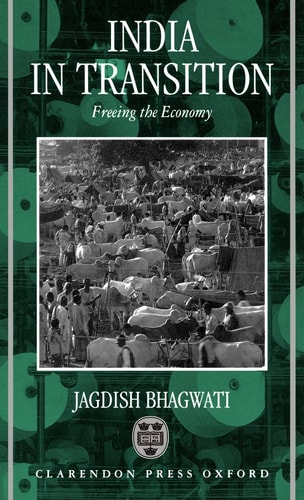
India in Transition: Freeing the Economy
0
0
As an Amazon Associate and affiliate partner, Menrva Books earns from qualifying purchases. Learn more
Author Description
Jagdish Bhagwati, one of the world's leading economists, offers a fascinating overview of the policies that produced India's sorry economic performance over a third of a century. His analysis puts into sharp focus the crippling effects of the inward-looking, bureaucratic regime that grew to Kafkaesque dimensions, starting in the early 1950s. It provides therefore a coherent and convincing rationale for the economic reforms begun in June 1991 by the new government of Prime Minister Rao. These reforms, also discussed by Professor Bhagwati, are thus set into historical and analytical perspective. Written with wit and elegance, this text of the 1992 Radhakrishnan Lectures at Oxford is readily accessible to a wide readership.
Menrva's Summary
THE THESIS
What factors contributed to India's prolonged period of economic stagnation, and how do the reforms initiated in 1991 address these systemic failures? Jagdish Bhagwati, a prominent economist, utilizes his extensive academic background to dissect the bureaucratic constraints that hindered India's growth from the 1950s through the early 1990s. By examining the shift from an inward-looking, state-controlled regime to a more liberalized framework, the author provides a rigorous analytical defense of the 1991 economic reforms. The text serves as both a historical record and a policy critique, contextualizing the transition within the broader scope of global economic development.
THE SCOPE MAP
What You Will Find
- Historical analysis of Indian economic policy from the 1950s to 1991
- Evaluation of the bureaucratic and regulatory hurdles known as the License Raj
- Assessment of the 1991 liberalization reforms under Prime Minister Rao
- Comparative perspective on inward-looking versus outward-looking economic strategies
THE AUTHORITY PERSPECTIVE
Experts recognize this work as a foundational text for understanding the shift in Indian economic policy during the early 1990s. Readers frequently note the clarity and accessibility of Bhagwati's prose, which distills complex macroeconomic concepts for a broader audience.
Page Count:
0
Publication Date:
1995-01-01
Publisher:
OUP
ISBN-10:
0195636376
ISBN-13:
9780195636376
Economics
History
Public Policy
India