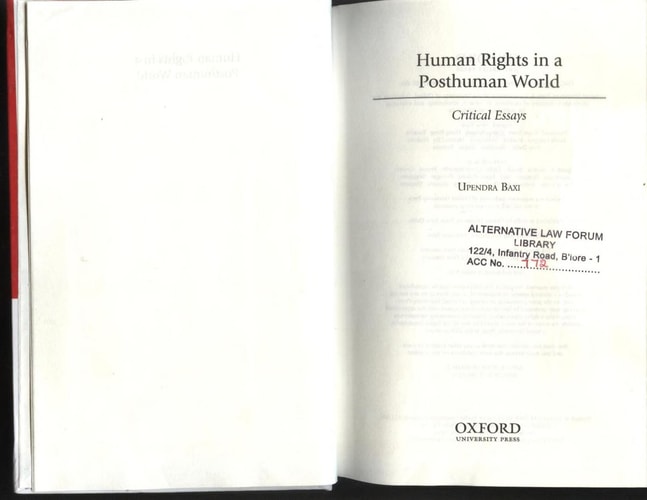
Human Rights in a Post Human World: Critical Essays
0
0
As an Amazon Associate and affiliate partner, Menrva Books earns from qualifying purchases. Learn more
Author Description
This important new work reflects on the contemporary human condition in a 'posthuman' and 'machinistic' world, almost overwhelmed by security concerns, terror and its politics, and technoscience. Exploring the role of human rights and development in such a world, Baxi contends that any serious analysis of human rights theory and practice must confront two critical realities. Firstly, that the new world economic and military orders, along with the continuing wars of and on 'terror', adversely impact global social and human development policies and programmes. Secondly, that emergent technologies, especially artificial intelligence, biotechnologies, and nano-technologies, generating the discourse of the posthuman, have serious implications for human rights. The book presents a critique of the approaches towards a theory of human rights proposed by Amartya Sen and his emphasis on the ethical, as opposed to the juridical nature of such rights. It proceeds to examine the complexities and contradictions of the ideology of development, and asks why there has been so little progress with regard to the right to development. It explores how in the current world scenario the 'emancipatory potential' of human rights may be carried forward in theoretical work and through activism.
Menrva's Summary
THE THESIS
This work investigates how the emergence of a posthuman, technoscientific world order necessitates a fundamental re-evaluation of human rights theory and practice. Upendra Baxi, a distinguished legal scholar, utilizes his extensive background in jurisprudence and social justice to critique current global economic and military frameworks. He argues that the convergence of advanced technologies and the politics of terror creates a precarious environment that undermines traditional human rights protections and development goals.
THE SCOPE MAP
What You Will Find
- Analysis of the impact of global military and economic orders on human development policies.
- Critical examination of the posthuman discourse surrounding artificial intelligence, biotechnology, and nanotechnology.
- A comparative critique of Amartya Sen’s ethical approach to human rights versus juridical frameworks.
- Exploration of the contradictions inherent in the ideology of development and the stagnation of the right to development.
- Theoretical and activist strategies for maintaining the emancipatory potential of human rights in the current era.
THE AUTHORITY PERSPECTIVE
Scholars and legal experts recognize this text as a rigorous intervention in contemporary human rights discourse, particularly for its focus on the intersection of technology and law. Readers frequently note the academic density of the prose, which demands a high level of familiarity with political theory and international law.
Page Count:
249
Publication Date:
2007-12-13
Publisher:
Oxford University Press
ISBN-10:
019569211X
ISBN-13:
9780195692112
Philosophy
Human rights
Globalization
Sociology
Technology