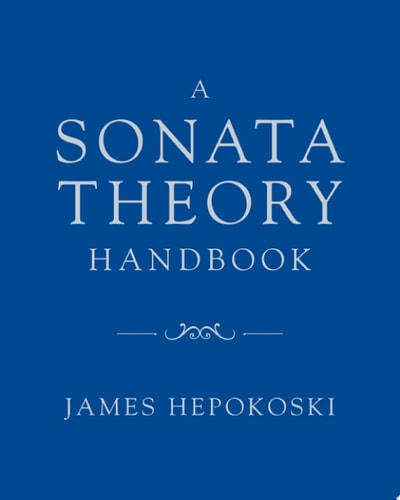
A Sonata Theory Handbook
0
0
As an Amazon Associate and affiliate partner, Menrva Books earns from qualifying purchases. Learn more
Author Description
Sonata form is the most commonly encountered organizational plan in the works of the classical-music masters, from Haydn, Mozart, and Beethoven to Schubert, Brahms, and beyond. Sonata Theory, an analytic approach developed by James Hepokoski and Warren Darcy in their award-winning Elements of Sonata Theory (2006), has emerged as one of the most influential frameworks for understanding this musical structure. What can this method from "the new Formenlehre" teach us about how these composers put together their most iconic pieces and to what expressive ends?In this new Sonata Theory Handbook, Hepokoski introduces readers step-by-step to the main ideas of this approach. At the heart of the book are close readings of eight individual movements ― from Mozart's Piano Sonata in B-flat, K. 333, to such structurally complex pieces as Schubert's "Death and the Maiden" String Quartet and the finale of Brahms's Symphony No 1 ― that show this analytical method in action. These illustrative analyses are supplemented with four updated discussions of the foundational concepts behind the theory, including dialogic form, expositional action zones, trajectories toward generically normative cadences, rotation theory, and the five sonata types. With its detailed examples and deep engagements with recent developments in form theory, schema theory, and cognitive research, this handbook updates and advances Sonata Theory and confirms its status as a key lens for analyzing sonata form.
Menrva's Summary
THE THESIS
This handbook investigates the structural and expressive mechanics of sonata form through the lens of Sonata Theory, a rigorous analytical framework. James Hepokoski, a prominent musicologist, provides a pedagogical guide that builds upon his previous collaborative work to demystify how classical masters organized their compositions. By applying specific analytical tools to eight distinct musical movements, the author demonstrates how this method reveals the intentionality behind complex harmonic and thematic choices. The text serves to refine and update the foundational concepts of the 'new Formenlehre' for both students and scholars of music history.
THE SCOPE MAP
What You Will Find
- Detailed analytical close readings of eight specific movements by composers including Mozart, Schubert, and Brahms.
- A comprehensive breakdown of core concepts such as dialogic form, expositional action zones, and rotation theory.
- Integration of recent developments in schema theory and cognitive research as applied to musical structure.
- A systematic classification of the five primary sonata types used in Western classical music.
THE AUTHORITY PERSPECTIVE
Experts recognize this work as a vital refinement of the influential Sonata Theory framework, offering a more accessible entry point for students. Readers frequently note the technical density of the prose, which requires a foundational understanding of music theory to fully grasp the analytical arguments presented.
Page Count:
348
Publication Date:
2020-12-15
Publisher:
Oxford University Press
ISBN-10:
0197536816
ISBN-13:
9780197536810
Music
Music
Music theory
Musicology
Reference
Community Tags
Similar Books