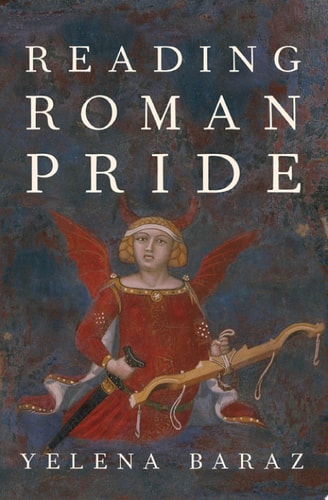
Reading Roman Pride
0
0
As an Amazon Associate and affiliate partner, Menrva Books earns from qualifying purchases. Learn more
Author Description
Pride is pervasive in Roman texts, as an emotion and a political and social concept implicated in ideas of power. This study examines Roman discourse of pride from two distinct complementary perspectives. The first is based on scripts, mini-stories told to illustrate what pride is, how it arises and develops, and where it fits within the Roman emotional landscape. The second is semantic, and draws attention to differences between terms within the pride field. The peculiar feature of Roman pride that emerges is that it appears exclusively as a negative emotion, attributed externally and condemned, up to the Augustan period. This previously unnoticed lack of expression of positive pride in republican discourse is a result of the way the Roman republican elite articulates its values as anti-monarchical and is committed, within the governing class, to power-sharing and a kind of equality. The book explores this uniquely Roman articulation of pride attributed to people, places, and institutions and traces the partial rehabilitation of pride that begins in the texts of the Augustan poets at the time of great political change. Reading for pride produces innovative readings of texts that range from Plautus to Ausonius, with major focus on Cicero, Livy, Vergil, and other Augustan poets.
Menrva's Summary
THE THESIS
This study investigates the conceptualization and linguistic expression of pride within Roman political and social discourse from the Republican period through the Augustan era. Yelena Baraz, a scholar of classical literature, utilizes a dual-methodological approach to analyze how Roman elites articulated values of power and equality. By examining both narrative scripts and semantic variations in terminology, the author argues that pride was historically viewed as a negative, externally attributed emotion due to the Republic's anti-monarchical commitments. The work demonstrates how this perception shifted during the political transitions of the Augustan age, leading to a partial rehabilitation of the concept in literature.
THE SCOPE MAP
What You Will Find
- Analysis of Roman emotional landscapes through narrative scripts and mini-stories.
- Semantic examination of Latin terminology related to pride and social status.
- Comparative study of texts ranging from Plautus to Ausonius.
- Investigation into the intersection of political power-sharing and emotional expression.
THE AUTHORITY PERSPECTIVE
Scholars and classicists recognize this work as a significant contribution to the study of Roman emotions and political culture. Readers frequently note the academic density of the prose and the precision with which the author connects linguistic shifts to broader historical changes in the Roman governing class.
Page Count:
339
Publication Date:
2020-01-01
Publisher:
Oxford University Press
ISBN-10:
019753161X
ISBN-13:
9780197531617
History
Philosophy
Ancient History
Special Topics
Sociology
English
English & College Success
History & Surveys
Literary Criticism
Community Tags
Other Editions(2)
Similar Books