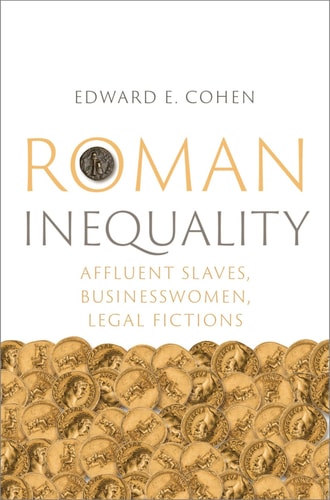
Roman Inequality: Affluent Slaves, Businesswomen, Legal Fictions
0
0
As an Amazon Associate and affiliate partner, Menrva Books earns from qualifying purchases. Learn more
Author Description
Roman Inequality explores how in Rome in the first and second centuries CE a number of male and female slaves, and some free women, prospered in business amidst a population of generally impoverished free inhabitants and of impecunious enslaved residents. Edward E. Cohen focuses on two anomalies to which only minimal academic attention has been previously directed: (1) the paradox of a Roman economy dependent on enslaved entrepreneurs who functioned, and often achieved considerable personal affluence, within a legal system that supposedly deprived unfree persons of all legal capacity and human rights; (2) the incongruity of the importance and accomplishments of Roman businesswomen, both free and slave, successfully operating under legal rules that in many aspects discriminated against women, but in commercial matters were in principle gender-blind and in practice generated egalitarian juridical conditions that often trumped gender-discriminatory customs. This book also examines the casuistry through which Roman jurists created "legal fictions" facilitating a commercial reality utterly incompatible with the fundamental precepts--inherently discriminatory against women and slaves---that Roman legal experts ("jurisprudents") continued explicitly to insist upon. Moreover, slaves' acquisition of wealth was actually aided by a surprising preferential orientation of the legal system: Roman law--to modern Western eyes counter-intuitively--in reality privileged servile enterprise, to the detriment of free enterprise.Beyond its anticipated audience of economic historians and students and scholars of classical antiquity, especially of Roman history and law, Roman Inequality will appeal to all persons working on or interested in gender and liberation issues.
Menrva's Summary
THE THESIS
How did the Roman legal system facilitate the economic success of enslaved entrepreneurs and businesswomen despite fundamental societal and legal constraints against them? Edward E. Cohen, a specialist in ancient economic history, investigates the paradoxes of the Roman commercial landscape during the first and second centuries CE. By analyzing the intersection of rigid legal theory and flexible commercial practice, Cohen argues that Roman law often functioned in ways that were surprisingly egalitarian regarding business, even while maintaining strict social hierarchies.
THE SCOPE MAP
What You Will Find
- Analysis of the economic activities of enslaved entrepreneurs and free businesswomen in the Roman Empire.
- Examination of the role of legal fictions in reconciling discriminatory statutes with commercial reality.
- Investigation into the preferential treatment of servile enterprise over free enterprise within Roman law.
- Case studies demonstrating the gap between the theoretical legal status of women and slaves and their practical business accomplishments.
THE AUTHORITY PERSPECTIVE
Scholars of classical antiquity and economic history recognize this work as a significant contribution to the understanding of Roman legal flexibility. Readers frequently note the dense, academic nature of the prose, which provides a rigorous examination of how Roman jurisprudence navigated complex social and economic contradictions.
Page Count:
277
Publication Date:
2023-01-01
Publisher:
Oxford University Press
ISBN-10:
0197687350
ISBN-13:
9780197687352
Economics
History
Roman Empire
World Civilization
Professional Career & Trade
Ancient History
Gender Studies
Economics history
Legal History
Community Tags
Similar Books