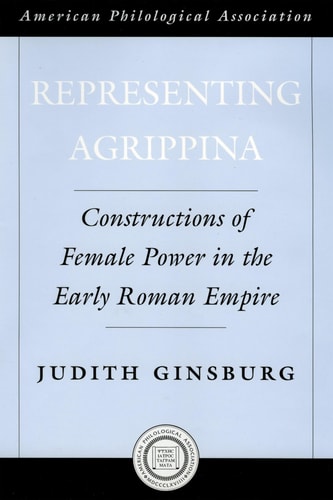
Representing Agrippina: Constructions of Female Power in the Early Roman Empire
0
0
As an Amazon Associate and affiliate partner, Menrva Books earns from qualifying purchases. Learn more
Author Description
Agrippina the Younger, wife of the emperor Claudius and mother of his successor Nero, wielded power and authority at the center of the Roman empire in ways unmatched by almost any other woman in Roman history. Such, at least, is the portrait of Agrippina delivered by our sources and perpetuated in modern scholarship. In this posthumous work, Judith Ginsburg provides a fresh look at both the literary and material representations of Agrippina. Unlike previous treatments, she seeks neither to condemn nor to rehabilitate Agrippina. Nor does she endeavor to exhume the "real Agrippina" from the embellished or fabricated portraits found among the ancients. Ginsburg trains her focus on the representations themselves. Her painstaking dissection of the portrayals by historians exposes the rhetorical tropes, the recurrent motifs, and the craft that shaped the literary image of Agrippina. The designs, as Ginsburg shows, were more than literary flourishes. They aimed to blur the boundaries between the domestic and the imperial realms, deploying the image of Agrippina as domineering wife and mother to suggest the flaws and instability of the regime, a dysfunctional family entailing a dysfunctional system of governance. Gender inversions at home played themselves out on the public scene as imperial rule compromised by female ascendancy. Distorted stereotypes of the "wicked stepmother," the domineering woman, and the sexual transgessor were applied to underscore the violations of status and disruption of gender relations that characterized the imperial administration. Ginsburg has as keen an eye for visual (mis)representations as for literary ones. The depictions of Agrippina on coinage and statuary provide a stark contrast with the written evidence. She appears as matron and priestess, emblematic of domestic rectitude and public piety, and a central figure in the continuity of the dynasty. Ginsburg incisively demonstrates the means whereby Agrippina's imagery was molded both to se
Menrva's Summary
THE THESIS
This work investigates how the literary and material representations of Agrippina the Younger were constructed to serve specific political agendas within the early Roman Empire. Judith Ginsburg, a scholar of Roman history, examines how ancient historians and contemporary visual media utilized Agrippina as a symbolic figure to critique the stability of the imperial regime. By moving away from attempts to uncover the 'real' Agrippina, the author focuses on the rhetorical and artistic mechanisms that transformed her into a vessel for anxieties regarding female power and dynastic legitimacy.
THE SCOPE MAP
What You Will Find
- Analysis of literary tropes and motifs used by ancient historians to characterize Agrippina.
- Comparative study of numismatic evidence and statuary versus written historical accounts.
- Examination of the intersection between domestic gender roles and imperial political stability.
- Exploration of how the 'wicked stepmother' archetype was deployed to signal systemic governance failures.
THE AUTHORITY PERSPECTIVE
Scholars recognize this text as a significant contribution to the study of Roman historiography and the construction of gendered power dynamics. Readers frequently note the analytical rigor with which Ginsburg contrasts visual propaganda with literary bias, making it a standard reference for those studying the Julio-Claudian dynasty.
Page Count:
160
Publication Date:
2005-12-01
Publisher:
Oxford University Press
ISBN-10:
0195181417
ISBN-13:
9780195181418
Biography
History
Rome
Gender Studies
Roman Empire
Ancient History
Community Tags
Other Editions(3)

Similar Books















Reader Comments
Share Your Thoughts
No comments yet. Be the first to share your thoughts!