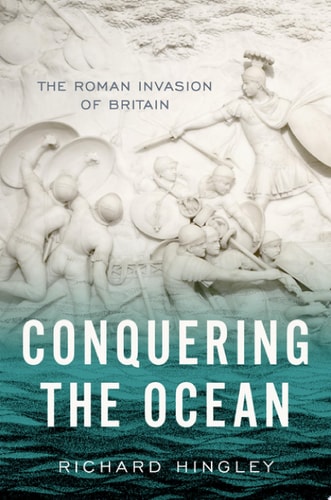
Conquering the Ocean: The Roman Invasion of Britain
0
0
As an Amazon Associate and affiliate partner, Menrva Books earns from qualifying purchases. Learn more
Author Description
An authoritative new history of the Roman conquest of BritainWhy did Julius Caesar come to Britain? His own account suggests that he invaded to quell a resistance of Gallic sympathizers in the region of modern-day Kent -- but there must have been personal and divine aspirations behind the expeditions in 55 and 54 BCE. To the ancients, the Ocean was a body of water that circumscribed the known world, separating places like Britain from terra cognita, and no one, not even Alexander the Great, had crossed it. While Caesar came and saw, he did not conquer. In the words of the historian Tacitus, "he revealed, rather than bequeathed, Britain to Rome." For the next five hundred years, Caesar's revelation was Rome's remotest imperial bequest.Conquering the Ocean provides a new narrative of the Roman conquest of Britain, from the two campaigns of Caesar up until the construction of Hadrian's Wall across the Tyne-Solway isthmus during the 120s CE. Much of the ancient literary record portrays this period as a long march of Roman progress but recent archaeological discoveries reveal that there existed a strong resistance in Britain, Boudica's short lived revolt being the most celebrated of them, and that Roman success was by no means inevitable. Richard Hingley here draws upon an impressive array of new information from archaeological research and recent scholarship on the classical sources to provide a balanced picture of the military activities and strategies that led to the conquest and subjugation of Britain. Conquering the Ocean is the fullest picture to date of a chapter in Roman military history that continues to captivate the public.
Menrva's Summary
THE THESIS
This book investigates the strategic, political, and cultural motivations behind the Roman conquest of Britain and the subsequent challenges of maintaining imperial control over the region. Richard Hingley, a scholar of Roman Britain, synthesizes classical literary accounts with modern archaeological data to challenge the traditional narrative of inevitable Roman expansion. He argues that the conquest was a complex, non-linear process characterized by significant indigenous resistance and logistical hurdles rather than a simple march of progress.
THE SCOPE MAP
What You Will Find
- A chronological analysis of Roman military activity from Julius Caesar's initial expeditions in 55 and 54 BCE to the construction of Hadrian's Wall in the 120s CE.
- An examination of the role of the Ocean as a symbolic and physical boundary in the Roman worldview.
- Integration of recent archaeological findings that highlight the scale and impact of British resistance, including the revolt of Boudica.
- A critical re-evaluation of classical sources such as Tacitus and Caesar's own commentaries.
THE AUTHORITY PERSPECTIVE
Experts recognize this work as a significant contribution to the study of Roman Britain, particularly for its successful integration of archaeological evidence with traditional historical texts. Readers frequently note the balanced approach the author takes in addressing both the Roman imperial perspective and the realities of indigenous resistance.
Page Count:
336
Publication Date:
2024-01-01
Publisher:
Oxford University Press
ISBN-10:
0197776892
ISBN-13:
9780197776896
History
Politics
Military History
Europe
Ancient History
Great Britain
European History
Roman Empire
Archaeology
Community Tags
Other Editions(2)
Similar Books