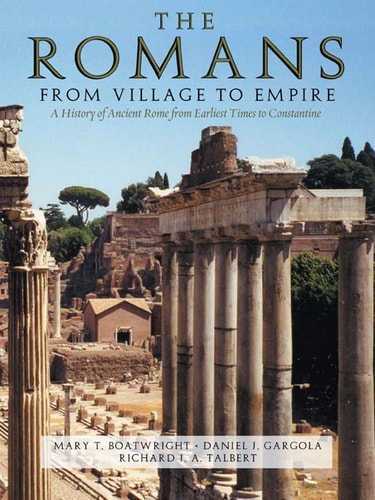
The Romans: From Village to Empire
0
0
As an Amazon Associate and affiliate partner, Menrva Books earns from qualifying purchases. Learn more
Author Description
How did a single village community in the Italian peninsula eventually become one of the most powerful imperial powers the world has ever known? In The Romans: From Village to Empire, Mary T. Boatwright, Daniel Gargola, and Richard J.A. Talbert explore this question as they guide readers through a comprehensive sweep of Roman history, ranging from the prehistoric settlements to the age of Constantine.Vividly written and accessible, The Romans traces Rome's remarkable evolution from village, to monarchy, to republic, and eventually to one-man rule by an emperor whose power at its peak stretched from Scotland to Iraq and the Nile Valley. Firmly grounded in ancient literary and material sources, the book describes and analyzes major political and military landmarks, from the Punic Wars, to Caesar's conquest of Gaul and his crossing of the Rubicon, to the victory of Octavian over Mark Antony, and to Constantine's adoption of Christianity. It also introduces such captivating individuals as Hannibal, Mithridates, Pompey, Cicero, Cleopatra, Augustus, Livia, Nero, Marcus Aurelius, and Shapur. The authors cover issues that still confront modern states worldwide, including warfare, empire building, consensus forging, and political fragmentation. They also integrate glimpses of many aspects of everyday Roman life and perspective--such as the role of women, literature, entertainment, town-planning, portraiture, and religion--demonstrating how Rome's growth as a state is inseparable from its social and cultural development.Ideal for courses in Roman history and Roman civilization, The Romans is enhanced by almost 100 illustrations, more than 30 maps (most produced by the Ancient World Mapping Center), and 22 textual extracts that provide fascinating cultural observations made by ancient Romans themselves.
Menrva's Summary
THE THESIS
How did a single village community in the Italian peninsula eventually become one of the most powerful imperial powers the world has ever known? The authors, all distinguished scholars in the field of classical history, utilize a combination of ancient literary texts and archaeological material evidence to construct a comprehensive chronological framework. By examining the transition from monarchy to republic and finally to imperial rule, the text argues that Rome's political expansion was inextricably linked to its evolving social and cultural structures. The narrative provides a rigorous analysis of the mechanisms of power, consensus, and military strategy that defined the Roman state.
THE SCOPE MAP
What You Will Find
- A chronological survey of Roman history from prehistoric settlements through the age of Constantine.
- Analysis of major political and military milestones including the Punic Wars and the rise of the Principate.
- Integration of social history topics such as the role of women, religion, town planning, and literature.
- Supplemental pedagogical tools including nearly 100 illustrations, 30 maps, and 22 primary source textual extracts.
THE AUTHORITY PERSPECTIVE
Experts and educators frequently identify this work as a foundational text for undergraduate courses in Roman history and civilization. Readers often note the balance between high-level political narrative and the inclusion of specific cultural observations that provide a well-rounded view of the ancient world.
Page Count:
516
Publication Date:
2004-01-01
Publisher:
Oxford University Press
ISBN-10:
0198027974
ISBN-13:
9780198027973
History
Non-Fiction
Rome
Ancient History
Roman History
Community Tags
Other Editions(2)
Similar Books
Reader Comments
Share Your Thoughts
No comments yet. Be the first to share your thoughts!