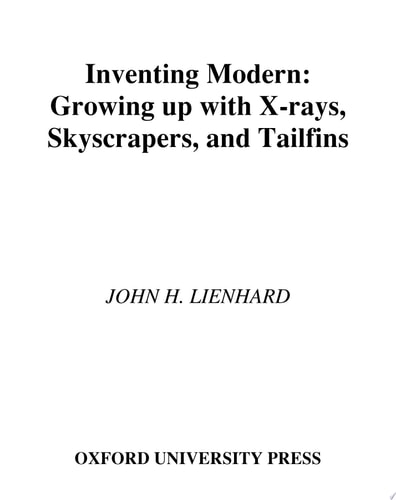
Inventing Modern: Growing Up With X-rays, Skyscrapers, And Tailfins
0
0
As an Amazon Associate and affiliate partner, Menrva Books earns from qualifying purchases. Learn more
Author Description
Modern is a word much used, but hard to pin down. In Inventing Modern, John H. Lienhard uses that word to capture the furious rush of newness in the first half of 20th-century America. An unexpected world emerges from under the more familiar Modern. Beyond the airplanes, radios, art deco, skyscrapers, Fritz Lang's Metropolis, Buck Rogers, the culture of the open road--Burma Shave, Kerouac, and White Castles--lie driving forces that set this account of Modern apart. One force, says Lienhard, was a new concept of boyhood--the risk-taking, hands-on savage inventor. Driven by an admiration of recklessness, America developed its technological empire with stunning speed. Bringing the airplane to fruition in so short a time, for example, were people such as Katherine Stinson, Lincoln Beachey, Amelia Earhart, and Charles Lindbergh. The rediscovery of mystery powerfully drove Modern as well. X-Rays, quantum mechanics, and relativity theory had followed electricity and radium. Here we read how, with reality seemingly altered, hope seemed limitless. Lienhard blends these forces with his childhood in the brave new world. The result is perceptive, engaging, and filled with surprise. Whether he talks about Alexander Calder (an engineer whose sculptures were exercises in materials science) or that wacky paean to flight, Flying Down to Rio, unexpected detail emerges from every tile of this large mosaic. Inventing Modern is a personal book that displays, rather than defines, an age that ended before most of us were born. It is an engineer's homage to a time before the bomb and our terrible loss of confidence--a time that might yet rise again out of its own postmodern ashes.
Menrva's Summary
THE THESIS
How did the rapid technological and cultural shifts of the early 20th century shape the American identity and the concept of modern life? John H. Lienhard, an engineer and historian, examines the first half of the 20th century by blending personal memoir with a broader analysis of technological progress. He argues that the era was defined by a unique combination of reckless innovation, a new cultural archetype of the 'savage inventor,' and a fascination with the mysterious nature of scientific discovery.
THE SCOPE MAP
What You Will Find
- Analysis of early 20th-century American technological milestones including aviation, radio, and architecture.
- Exploration of the 'savage inventor' archetype and its impact on rapid industrial development.
- Examination of scientific breakthroughs like X-rays, quantum mechanics, and relativity as drivers of cultural optimism.
- Personal reflections on childhood experiences within the context of a changing technological landscape.
THE AUTHORITY PERSPECTIVE
Experts and readers frequently note the book's unique ability to synthesize engineering history with personal narrative. It is often cited as a thoughtful reflection on the optimism of the pre-atomic age and the evolution of American technological confidence.
Page Count:
0
Publication Date:
2003-01-01
Publisher:
Oxford University Press
ISBN-10:
0198036361
ISBN-13:
9780198036364
Memoir
History
20th Century
American History
Technology
Engineering
Community Tags
Similar Books