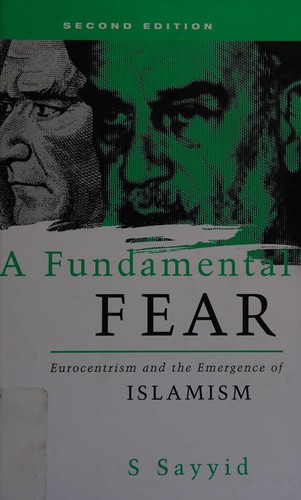
A Fundamental Fear
0
0
As an Amazon Associate and affiliate partner, Menrva Books earns from qualifying purchases. Learn more
Author Description
This is a provocative account of the ways in which Muslim identities have come to play an increasingly political role in recent years. Theoretically innovative, it shows how Islamic movements - despite the wide variety of their manifestations - are best understood as a continuation of political and cultural decolonization. This study draws upon the full breadth of post-structuralist thought as a means of better understanding Islamism. As such, it is necessary reading for all those who are interested in the Muslim world - in both its state and diasporic forms - as well as academics concerned with questions of 'race' and place in a poststructuralist context.--Jacket.
Menrva's Summary
THE THESIS
This book investigates how Muslim identities have become central to political discourse and action in contemporary times. It argues that Islamic movements, despite their diverse expressions, are a continuation of decolonization processes. The study employs post-structuralist theory to analyze Islamism, examining both state and diasporic Muslim communities. It seeks to understand the complex interplay of 'race' and place within a post-structuralist framework.
THE SCOPE MAP
- Analysis of the political role of Muslim identities in recent years.
- Theoretical framework drawing on post-structuralist thought.
- Examination of Islamic movements as a continuation of decolonization.
- Study of both state and diasporic forms of Muslim communities.
- Exploration of 'race' and place in a poststructuralist context.
THE AUTHORITY PERSPECTIVE
This study is positioned as a theoretically innovative account of the political significance of Muslim identities. It is presented as essential reading for those interested in the Muslim world and academics focused on 'race' and place. The book's engagement with post-structuralist thought aims to provide a deeper understanding of Islamism. Its scope encompasses both state-based and diasporic Muslim populations.
Page Count:
185
Publication Date:
2003-01-01
ISBN-10:
1842771965
Non-Fiction
History
Politics
Identity politics
Islam
Sociology
Community Tags
Similar Books