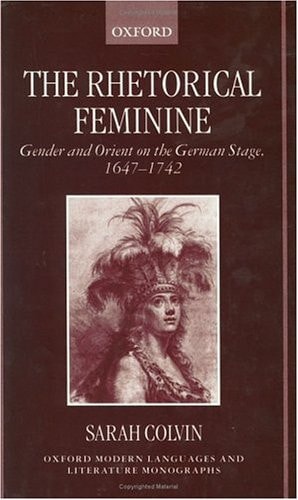
The Rhetorical Feminine: Gender and Orient on the German Stage, 1647-1742
0
0
As an Amazon Associate and affiliate partner, Menrva Books earns from qualifying purchases. Learn more
Author Description
This book takes a fresh look at theatre - including the important new genre of opera - in early modern Germany. Taking as a starting-point the importance of rhetoric in early modern boys' education, this study considers the relationship between theatre, persuasion, and social stability, and looks at how the stage helps to develop ideas about women and non-Christian peoples which have not lost their relevance today.
Menrva's Summary
THE THESIS
This study investigates how early modern German theatre and opera functioned as rhetorical instruments to construct and reinforce societal perceptions of gender and cultural alterity. Sarah Colvin, a scholar of German literature and culture, utilizes the historical framework of early modern educational practices, specifically the emphasis on rhetoric in boys' schooling, to analyze how theatrical performance served as a mechanism for social stability. By examining the intersection of persuasion and representation, the author argues that the stage played a critical role in codifying contemporary attitudes toward women and non-Christian populations.
THE SCOPE MAP
What You Will Find
- Analysis of German theatrical and operatic productions between 1647 and 1742
- Examination of the role of rhetoric in early modern pedagogical systems
- Exploration of the construction of the 'feminine' and the 'orient' within dramatic texts
- Discussion on the enduring legacy of early modern representational tropes in modern discourse
THE AUTHORITY PERSPECTIVE
Scholars in the field of German studies recognize this monograph as a rigorous contribution to the understanding of early modern performance culture. Experts frequently highlight the text's ability to bridge the gap between historical pedagogical methods and the evolution of cultural identity on the stage.
Page Count:
344
Publication Date:
1999-10-28
Publisher:
Clarendon Press
ISBN-10:
0198186363
ISBN-13:
9780198186366
History
Theater
Gender Studies
Theatre History
German
Literary Criticism
Community Tags
Similar Books