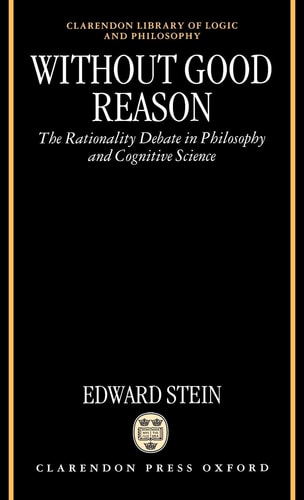
Without Good Reason: The Rationality Debate in Philosophy and Cognitive Science
0
0
As an Amazon Associate and affiliate partner, Menrva Books earns from qualifying purchases. Learn more
Author Description
In this book, Edward Stein offers a clear critical account of the debate about rationality in philosophy and cognitive science. He discusses concepts of rationality--the pictures of rationality on which the debate centers--and assesses the empirical evidence used to argue that humans are irrational. He concludes that the question of human rationality must be answered not conceptually but empirically, using the full resources of an advanced cognitive science. Furthermore, he extends this conclusion to argue that empirical considerations are also relevant to the theory of knowledge--in other words, that epistemology should be naturalized.
Menrva's Summary
THE THESIS
This book investigates whether human beings are inherently rational and how the debate surrounding this question should be resolved. Edward Stein, a scholar in philosophy and cognitive science, examines the competing conceptual frameworks that define rationality. He critiques the empirical evidence often cited to support claims of human irrationality and proposes that the resolution to this debate lies in the integration of advanced cognitive science rather than purely conceptual analysis. Ultimately, Stein argues for a naturalized epistemology, asserting that empirical findings are essential to the development of knowledge theory.
THE SCOPE MAP
What You Will Find
- A critical analysis of the rationality debate within contemporary philosophy and cognitive science.
- An assessment of empirical studies regarding human reasoning and cognitive biases.
- A methodological argument for the naturalization of epistemology.
- A synthesis of philosophical concepts and empirical data to address the nature of human rationality.
THE AUTHORITY PERSPECTIVE
Experts recognize this work as a significant contribution to the intersection of philosophy and psychology, often citing it for its rigorous approach to the rationality debate. Readers frequently note the academic density of the prose, which makes it a foundational text for those studying the philosophical implications of cognitive science.
Page Count:
312
Publication Date:
1996-01-25
Publisher:
Clarendon Press
ISBN-10:
0198235747
ISBN-13:
9780198235743
Psychology
Philosophy
Logic
Human beings
Reason
Reasoning
Epistemology