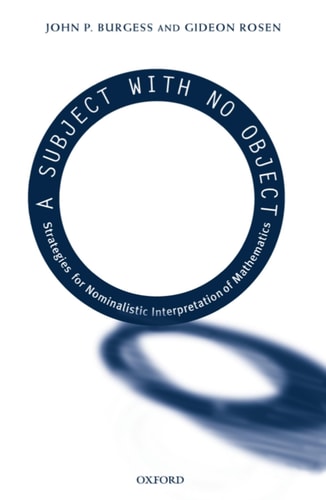
A Subject with No Object: Strategies for Nominalistic Interpretation of Mathematics
0
0
As an Amazon Associate and affiliate partner, Menrva Books earns from qualifying purchases. Learn more
Author Description
Numbers and other mathematical objects are exceptional in having no locations in space or time or relations of cause and effect. This makes it difficult to account for the possibility of the knowledge of such objects, leading many philosophers to embrace nominalism, the doctrine that there are no such objects, and to embark on ambitious projects for interpreting mathematics so as to preserve the subject while eliminating its objects. This book cuts through a host of technicalities that have obscured previous discussions of these projects, and presents clear, concise accounts of a dozen strategies for nominalistic interpretation of mathematics, thus equipping the reader to evaluate each and to compare different ones. The authors also offer critical discussion, rare in the literature, of the aims and claims of nominalistic interpretation, suggesting that it is significant in a very different way from that usually assumed.
Menrva's Summary
THE THESIS
This book investigates whether mathematics can be meaningfully interpreted without the existence of abstract mathematical objects. Authors Gideon Rosen and John P. Burgess, both established philosophers of mathematics, utilize a rigorous analytical framework to examine the doctrine of nominalism. They evaluate the philosophical necessity of mathematical entities by dissecting various strategies designed to preserve mathematical discourse while denying the reality of its traditional objects.
THE SCOPE MAP
What You Will Find
- A comparative analysis of twelve distinct strategies for nominalistic interpretation.
- A critical evaluation of the ontological commitments inherent in mathematical language.
- Discussion of the epistemological challenges posed by non-spatiotemporal objects.
- An assessment of the broader philosophical significance of nominalist projects.
THE AUTHORITY PERSPECTIVE
Experts recognize this work as a foundational text for those navigating the intersection of nominalism and the philosophy of mathematics. Readers frequently note the clarity with which the authors distill complex technical arguments into accessible philosophical discourse.
Page Count:
272
Publication Date:
2000-04-20
Publisher:
Oxford University Press
ISBN-10:
0198250126
ISBN-13:
9780198250128
Philosophy
Mathematics
Epistemology
Mathematical Analysis
Logic
Metaphysics
Community Tags
Similar Books