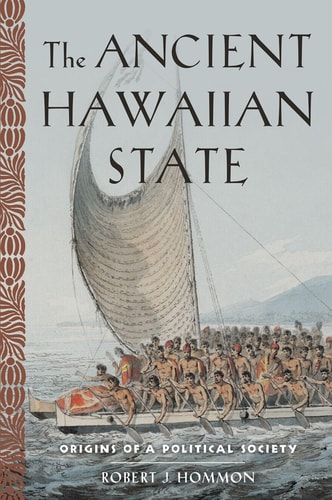
The Ancient Hawaiian State: Origins of a Political Society
0
0
As an Amazon Associate and affiliate partner, Menrva Books earns from qualifying purchases. Learn more
Author Description
The well-known list of "cradles of civilization" primary states from which all modern nation states ultimately derive, has traditionally been limited to Egypt, Mesopotamia, the Indus Valley, China, Mesoamerica, and Andean South America. However, by drawing on archaeological and ethnohistorical sources, Robert J. Hommon demonstrates that Polynesia, with primary states in both Hawai`i and Tonga, should be added to that list. The Ancient Hawaiian State offers a history of the ancient Hawaiians' transformation of their Polynesian chiefdoms into primary state societies. The emergence of primary states is one of the most revolutionary transformations in human history, and Hawai`i's metamorphosis was so profound that in some ways the contact-era Hawaiian states bear a closer resemblance to our world than to that of their closely-related Eastern Polynesian contemporaries. In contrast to the other six regions, in which states emerged in the distant, proto- or pre-literate past, the transformation of Hawaiian states is documented in an extensive body of oral traditions preserved in written form, a rich literature of early post-contact eyewitness accounts by participants and Western visitors, as well as an extensive archaeological record. Tracing the roots and emergence of the Hawaiian states, this innovative study offers a detailed model that will advance the analysis of Polynesian political development and shed light on the nature and dynamics of primary state formation.
Menrva's Summary
THE THESIS
This work investigates whether the ancient Hawaiian political system qualifies as a primary state, challenging the traditional exclusion of Polynesia from the global list of early civilizations. Robert J. Hommon, an expert in Hawaiian archaeology, synthesizes extensive archaeological data and ethnohistorical records to argue that the transformation of Polynesian chiefdoms into state societies in Hawaii and Tonga represents a significant, documented instance of primary state formation. By comparing these developments to established cradles of civilization, the author provides a framework for understanding the political evolution of the Hawaiian islands.
THE SCOPE MAP
What You Will Find
- Analysis of the transition from chiefdoms to primary states in Hawaii and Tonga.
- Integration of oral traditions, post-contact eyewitness accounts, and archaeological evidence.
- A theoretical model for analyzing political development in Polynesian societies.
Scope Limits
- The study focuses specifically on the political evolution of Hawaii and Tonga rather than a comprehensive history of all Polynesian islands.
- It does not provide a general survey of Pacific migration patterns outside the context of state formation.
THE AUTHORITY PERSPECTIVE
Scholars and historians recognize this text as a significant contribution to the study of political anthropology and Pacific history. Readers frequently note the academic density of the prose and the author's meticulous use of interdisciplinary evidence to support his claims.
Page Count:
336
Publication Date:
2016-09-01
Publisher:
Oxford University Press
ISBN-10:
0190499125
ISBN-13:
9780190499129
History
Archaeology
Social Life
Anthropology
Hawaii
Politics & Government
Community Tags
Similar Books