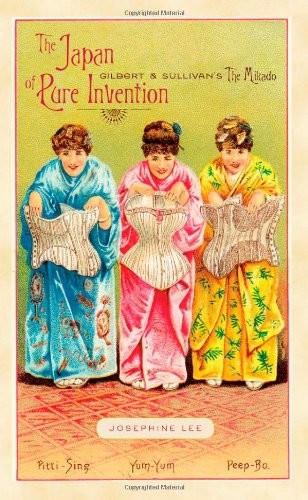
The Japan of Pure Invention
0
0
As an Amazon Associate and affiliate partner, Menrva Books earns from qualifying purchases. Learn more
Author Description
Long before Sofia Coppola's Lost in Translation, long before Barthes explicated his empire of signs, even before Puccini's Madame Butterfly, Gilbert and Sullivan's The Mikado presented its own distinctive version of Japan. Set in a fictional town called Titipu and populated by characters named Yum-Yum, Nanki-Poo, and Pooh-Bah, the opera has remained popular since its premiere in 1885. Tracing the history of The Mikado's performances from Victorian times to the present, Josephine Lee reveals the continuing viability of the play's surprisingly complex racial dynamics as they have been adapted.
Menrva's Summary
THE THESIS
This book investigates the enduring and adaptable racial dynamics within Gilbert and Sullivan's opera, The Mikado. Josephine Lee traces the performance history of The Mikado from its 1885 premiere to the present day, examining how its portrayal of a fictionalized Japan and its characters has been reinterpreted across different eras. The study focuses on the opera's surprisingly complex racial underpinnings and their continued relevance as the work has been adapted for various audiences and contexts.
THE SCOPE MAP
- Analysis of The Mikado's performance history from Victorian times to the present.
- Exploration of the opera's complex racial dynamics.
- Examination of how the play's representation of Japan has been adapted over time.
- Discussion of the opera's enduring popularity and cultural impact.
- Focus on the fictional town of Titipu and its inhabitants.
- Contextualization within broader discussions of representation and cultural appropriation.
THE AUTHORITY PERSPECTIVE
The book offers a detailed examination of the cultural reception and adaptation of Gilbert and Sullivan's The Mikado. It highlights how the opera's portrayal of Japan, set in the fictional Titipu with characters like Yum-Yum and Pooh-Bah, has been a site for evolving discussions on race and representation since its 1885 debut. The analysis suggests that the opera's complex racial dynamics remain surprisingly viable and adaptable, continuing to resonate with audiences through various performance iterations. This scholarly approach provides insight into the long-term cultural life of a popular operetta.
Page Count:
280
Publication Date:
2010-01-01
ISBN-10:
0816665796
ISBN-13:
9780816665792
Non-Fiction
Literary Fiction
Art
History
Performance Studies
Literary Criticism
Asian Studies