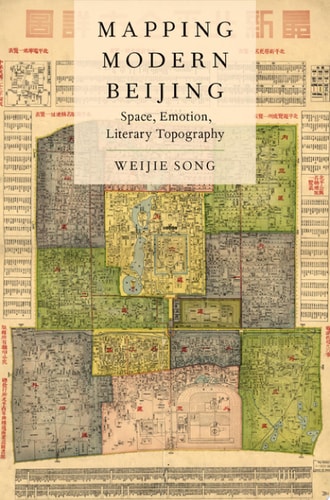
Mapping Modern Beijing: Space, Emotion, Literary Topography
0
0
As an Amazon Associate and affiliate partner, Menrva Books earns from qualifying purchases. Learn more
Author Description
Mapping Modern Beijing investigates the five methods of representing Beijing-a warped hometown, a city of snapshots and manners, an aesthetic city, an imperial capital in comparative and cross-cultural perspective, and a displaced city on the Sinophone and diasporic postmemory-by authors travelling across mainland China, Taiwan, Hong Kong, and overseas Sinophone and non-Chinese communities. The metamorphosis of Beijing's everyday spaces and the structural transformation of private and public emotions unfold Manchu writer Lao She's Beijing complex about a warped native city. Zhang Henshui's popular snapshots of fleeting shocks and everlasting sorrows illustrate his affective mapping of urban transition and human manners in Republican Beijing. Female poet and architect Lin Huiyin captures an aesthetic and picturesque city vis-à-vis the political and ideological urban planning. The imagined imperial capital constructed in bilingual, transcultural, and comparative works by Lin Yutang, Princess Der Ling, and Victor Segalen highlights the pleasures and pitfalls of collecting local knowledge and presenting Orientalist and Cosmopolitan visions. In the shadow of World Wars and Cold War, a multilayered displaced Beijing appears in the Sinophone postmemory by diasporic Beijing native Liang Shiqiu, Taiwan sojourners Zhong Lihe and Lin Haiyin, and émigré martial arts novelist Jin Yong in Hong Kong. Weijie Song situates Beijing in a larger context of modern Chinese-language urban imaginations, and charts the emotional topography of the city against the backdrop of the downfall of the Manchu Empire, the rise of modern nation-state, the 1949 great divide, and the formation of Cold War and globalizing world.Drawing from literary canons to exotic narratives, from modernist poetry to chivalric fantasy, from popular culture to urban planning, Song explores the complex nexus of urban spaces, archives of emotions, and literary topography of Beijing in its long journey from imperial capital.
Menrva's Summary
THE THESIS
This work investigates how Beijing is represented across diverse literary and cultural texts to reveal the intersection of urban space, personal emotion, and historical transformation. Weijie Song, an associate professor of Chinese literature, utilizes a multidisciplinary framework that combines urban studies, literary analysis, and historical inquiry. By examining authors from mainland China, Taiwan, Hong Kong, and the diaspora, the book argues that Beijing serves as a shifting site of memory and identity shaped by the collapse of the Manchu Empire and the subsequent rise of the modern nation-state.
THE SCOPE MAP
What You Will Find
- Analysis of five distinct representational methods: the warped hometown, the city of snapshots, the aesthetic city, the imperial capital, and the displaced city.
- Examination of works by Lao She, Zhang Henshui, Lin Huiyin, Lin Yutang, Princess Der Ling, Victor Segalen, Liang Shiqiu, Zhong Lihe, Lin Haiyin, and Jin Yong.
- Integration of urban planning documents, popular culture, and literary canons to map emotional topography.
Scope Limits
- The study focuses primarily on literary and cultural representations rather than comprehensive architectural or demographic history.
- It prioritizes the Sinophone and diasporic perspective, potentially limiting the scope of non-Chinese indigenous urban narratives.
THE AUTHORITY PERSPECTIVE
Scholars in the field of modern Chinese literature recognize this text as a significant contribution to the study of urban imagination and spatial theory. Readers frequently note the academic density of the prose, which requires a foundational understanding of twentieth-century Chinese history and literary movements.
Page Count:
318
Publication Date:
2017-01-01
Publisher:
Oxford University Press
ISBN-10:
0190692847
ISBN-13:
9780190692841
Chinese History
Criticism history
English & College Success
Literary Criticism
English
Asian Studies
Urban Studies
Community Tags
Similar Books