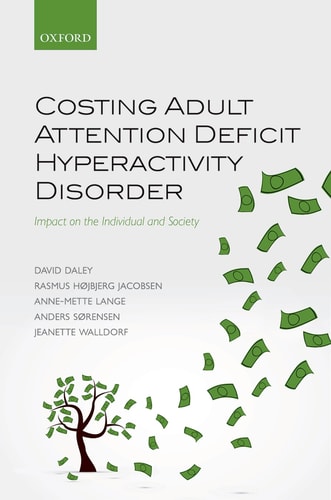
Costing Adult Attention Deficit Hyperactivity Disorder: Impact on the Individual and Society
0
0
As an Amazon Associate and affiliate partner, Menrva Books earns from qualifying purchases. Learn more
Author Description
The rapid increase in recent years in the number of children and adults accessing care for ADHD (Attention Deficit Hyperactivity Disorder), raises a number of questions. It is unclear whether the increase is due to an increased public and professional recognition and awareness of ADHD as a debilitating human condition or to an actual increase in the incidence of individuals suffering from ADHD. Depending on the reasons behind the increased burden on services, and whether more effective treatments can be found, the future costs to society could be enormous. The study presented in this book estimates the private and social costs of ADHD.The key focus of this book is to study the costs related to individuals with ADHD who have not been diagnosed and who have not received treatment. In this respect, the study makes a unique contribution to scientific knowledge by investigating the cost of untreated ADHD. The study investigates the extent to which individuals with undiagnosed ADHD in childhood fare differently compared to otherwise similar individuals without ADHD. A long list of important parameters in an individual's life, e.g. educational attainment, occupational status, income, family situation, criminal record, health is examined. The results of the study provide not just cost estimates of ADHD; per se, but also create a point of reference which will be highly relevant for the evaluation of any future treatment for ADHD.The clear picture emerging from this study is that ADHD is associated with considerable private and social costs, reflecting that Adults with ADHD exhibit weak performance across all applied measures. These findings remain even when adults with ADHD are compared to a control group of their own siblings Even though the study is performed for Denmark it is argued that generalizability of the established results beyond Denmark is valid.
Menrva's Summary
THE THESIS
This book investigates the economic and social burden of Attention Deficit Hyperactivity Disorder (ADHD) on both the individual and society, specifically focusing on the long-term consequences of untreated cases. The authors, a team of researchers including Anders Sørensen and David Daley, utilize longitudinal data to analyze how undiagnosed ADHD impacts life outcomes such as educational attainment, occupational status, and criminal involvement. By comparing individuals with ADHD to control groups, including siblings, the study establishes a quantitative baseline for the private and social costs associated with the condition.
THE SCOPE MAP
What You Will Find
- Longitudinal analysis of life outcomes including income, employment, and education.
- Comparative study of individuals with ADHD versus a control group of siblings.
- Economic modeling of the societal costs of untreated ADHD.
- Evaluation of the long-term impact of ADHD on family stability and criminal records.
THE AUTHORITY PERSPECTIVE
Experts identify this work as a significant contribution to the economic study of mental health, providing a rigorous framework for assessing the societal impact of ADHD. Readers frequently note the academic density of the prose and the specific focus on the Danish population as a model for broader international application.
Page Count:
268
Publication Date:
2021-01-01
Publisher:
Oxford University Presss,
ISBN-10:
0198745559
ISBN-13:
9780198745556
Economics
Health
Psychology
Sociology
Public Policy
Community Tags
Other Editions(2)
Similar Books













Reader Comments
Share Your Thoughts
No comments yet. Be the first to share your thoughts!