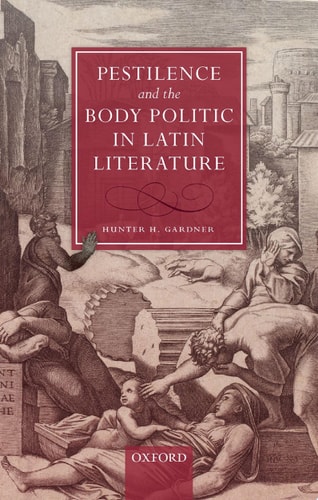
Pestilence and the Body Politic in Latin Literature
0
0
As an Amazon Associate and affiliate partner, Menrva Books earns from qualifying purchases. Learn more
Author Description
Scientists, journalists, novelists, and filmmakers continue to generate narratives of contagious disease, stories shaped by a tradition of disease discourse that extends to early Greco-Roman literature. Lucretius, Vergil, and Ovid developed important conventions of the western plague narrative as a response to the breakdown of the Roman res publica in the mid-first century CE and the reconstitution of stabilized government under the Augustan Principate (31 BCE-14 CE): relying on the metaphoric relationship between the human body and the body politic, these authors used largely fictive representations of epidemic disease to address the collapse of the social order and suggest remedies for its recovery.Theorists such as Susan Sontag and Rene Girard have observed how the rhetoric of disease frequently signals social, psychological, or political pathologies, but their observations have rarely been applied to Latin literary practices. Pestilence and the Body Politic in Latin Literature explores how the origins and spread of outbreaks described by Roman writers enact a drama in which the concerns of the individual must be weighed against those of the collective, staged in an environment signalling both reversion to a pre-historic Golden Age and the devastation characteristic of a post-apocalyptic landscape. Such innovations in Latin literature have impacted representations as diverse as Carlo Coppola's paintings of a seventeenth-century outbreak of bubonic plague in Naples and Margaret Atwood's Maddaddam Trilogy. Understanding why Latin writers developed these tropes for articulating contagious disease and imbuing it with meaning for the collapse of the Roman body politic allows us to clarify what more recent disease discourses mean both for their creators and for the populations they afflict in contemporary media.
Menrva's Summary
THE THESIS
This work investigates how early Greco-Roman literature established the foundational tropes of the western plague narrative to articulate the collapse and reconstitution of the Roman body politic. Hunter H. Gardner examines the writings of Lucretius, Vergil, and Ovid, arguing that these authors utilized the metaphor of the diseased human body to diagnose social and political pathologies during the transition from the Roman Republic to the Augustan Principate. By analyzing these ancient texts, the author provides a framework for understanding how disease discourse functions as a mechanism for addressing societal instability and collective recovery.
THE SCOPE MAP
What You Will Find
- Analysis of plague narratives in the works of Lucretius, Vergil, and Ovid.
- Examination of the metaphoric relationship between the human body and the Roman state.
- Application of theoretical perspectives from Susan Sontag and Rene Girard to Latin literary practices.
- Comparative study linking ancient Roman tropes to modern representations in contemporary media and literature.
THE AUTHORITY PERSPECTIVE
Scholars recognize this text as a significant contribution to the study of classical literature and its enduring influence on modern disease discourse. Readers frequently note the academic density of the prose, which provides a rigorous examination of how ancient political anxieties continue to shape contemporary narratives of contagion.
Page Count:
320
Publication Date:
2019-09-11
Publisher:
Oxford University Press
ISBN-10:
0198796420
ISBN-13:
9780198796428
History
Epidemics
Literary Criticism
Criticism history
Rome
Ancient History
Community Tags
Other Editions(2)
Similar Books















Reader Comments
Share Your Thoughts
No comments yet. Be the first to share your thoughts!