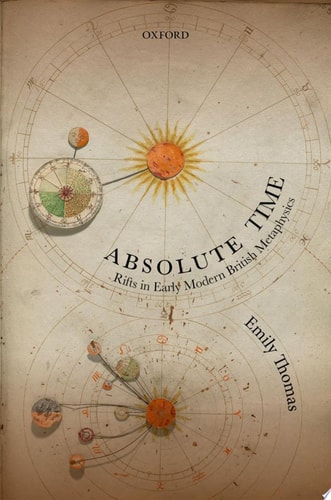
Absolute Time: Rifts in Early Modern British Metaphysics
0
0
As an Amazon Associate and affiliate partner, Menrva Books earns from qualifying purchases. Learn more
Author Description
What is time? This is one of the most fundamental questions we can ask. Traditionally, the answer was that time is a product of the human mind, or of the motion of celestial bodies. In the mid-seventeenth century, a new kind of answer emerged: time or eternal duration is 'absolute', in the sense that it is independent of human minds and material bodies.Emily Thomas explores the development of absolute time or eternal duration during one of Britain's richest and most creative metaphysical periods, from the 1640s to the 1730s. She introduces an interconnected set of main characters - Henry More, Walter Charleton, Isaac Barrow, Isaac Newton, John Locke, Samuel Clarke, and John Jackson - alongside a large and varied supporting cast, whose metaphysical views are all read in their historical context and given a place in the seventeenth- and eighteenth-century development of thought about time.In addition to interpreting the metaphysics of these thinkers, Absolute Time advances two general, developmental theses. First, the complexity of positions on time (and space) defended in early modern thought is hugely under-appreciated. Second, distinct kinds of absolutism emerged in British philosophy, helping us to understand why some absolutists considered time to be barely real, whilst others identified it with the most real being of all: God.
Menrva's Summary
THE THESIS
This book investigates the emergence and evolution of the concept of absolute time within British metaphysical thought during the seventeenth and eighteenth centuries. Emily Thomas, a scholar specializing in the history of philosophy, examines how thinkers transitioned from viewing time as a human construct or celestial motion to an independent, eternal duration. By analyzing the works of figures such as Isaac Newton, Henry More, and John Locke, the author argues that early modern absolutism was far more nuanced than previously recognized, ranging from views of time as a secondary reality to its identification with the divine.
THE SCOPE MAP
What You Will Find
- A detailed examination of British metaphysical discourse from the 1640s to the 1730s.
- Comparative analysis of seven primary philosophers including Isaac Barrow, Samuel Clarke, and John Jackson.
- A taxonomy of distinct absolutist frameworks regarding the nature of time and space.
- Historical contextualization of how metaphysical theories were influenced by the scientific and theological shifts of the era.
THE AUTHORITY PERSPECTIVE
Scholars and students of early modern philosophy frequently cite this work for its rigorous archival research and its ability to clarify complex metaphysical debates. Experts highlight the text as a significant contribution to the field, noting that it successfully challenges simplified historical narratives regarding the development of time-related theories.
Page Count:
256
Publication Date:
2018-06-05
Publisher:
Oxford University Press
ISBN-10:
0198807937
ISBN-13:
9780198807933
Philosophy
Metaphysics
History & Surveys
British Philosophy
Time
Community Tags
Similar Books