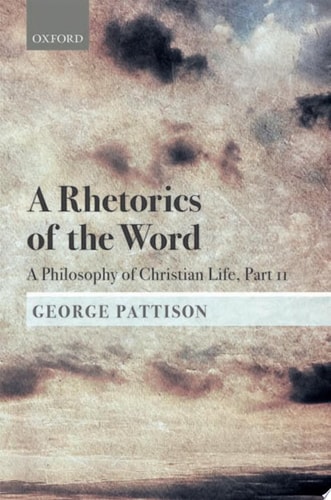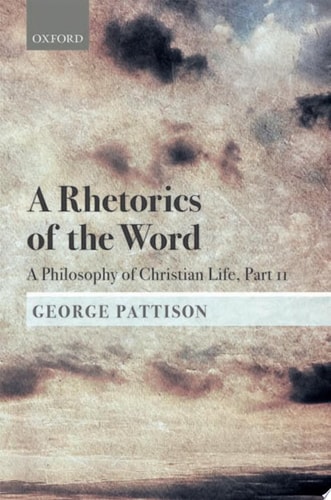
A Rhetorics of the Word: A Philosophy of Christian Life, Part II
0
0
As an Amazon Associate and affiliate partner, Menrva Books earns from qualifying purchases. Learn more
Author Description
A Rhetorics of the Word is the second volume of a three-part philosophy of Christian life. It approaches Christian life as expressive of a divine calling or vocation. The word Church (ekklesia) and the role of naming in baptism indicate the fundamental place of calling in Christian life. However, ideas of vocation are difficult to access in a world shaped by the experience of disenchantment. The difficulties of articulating vocation are explored with reference to Weber, Heidegger, and Kierkegaard. These are further connected to a general crisis of language, manifesting in the degradation of political discourse (Arendt) and the impact of new communications technology on human discourse. This impact can be seen as reinforcing an occlusion of language in favour of rationality already evidenced in the philosophical tradition and technocratic management. New possibilities for thinking vocation are pursued through the biblical prophets (with emphasis on Buber's and Rosenzweig's reinterpretation of the call of Moses), Saint John, and Russian philosophies of language (Florensky to Bakhtin). Vocation emerges as bound up with the possibility of being name-bearers, enabling a mutuality of call and response. This is then evidenced further in ethics and poetics, where Levinas and Hermann Broch (The Death of Virgil) become major points of reference. In conclusion, the themes of calling and the name are seen to shape the possibility of love-the subject of the final part of the philosophy of Christian life: A Metaphysics of Love.
Menrva's Summary
THE THESIS
How can the concept of vocation be articulated and understood within a modern world defined by disenchantment and the degradation of language? George Pattison, a scholar of modern European philosophy and theology, investigates the intersection of divine calling and human discourse. By synthesizing historical theological perspectives with modern philosophical critiques, he argues that the act of naming and the capacity for call-and-response are essential to reclaiming a meaningful Christian life in a technocratic age.
THE SCOPE MAP
What You Will Find
- Philosophical analysis of vocation through the works of Weber, Heidegger, and Kierkegaard.
- Examination of the crisis of language as influenced by Arendt and modern communications technology.
- Theological reinterpretation of the prophetic call using Buber, Rosenzweig, and Russian linguistic philosophy.
- Ethical and poetic frameworks derived from the writings of Levinas and Hermann Broch.
THE AUTHORITY PERSPECTIVE
Scholars and theologians identify this work as a rigorous contribution to contemporary systematic theology, noting its dense engagement with continental philosophy. It is frequently cited as a foundational text for those examining the intersection of linguistic theory and the Christian experience of vocation.
Page Count:
288
Publication Date:
2020-02-16
Publisher:
Oxford University Press
ISBN-10:
0198813511
ISBN-13:
9780198813514
Philosophy
Religion
Christian Theology
Ethics
Language