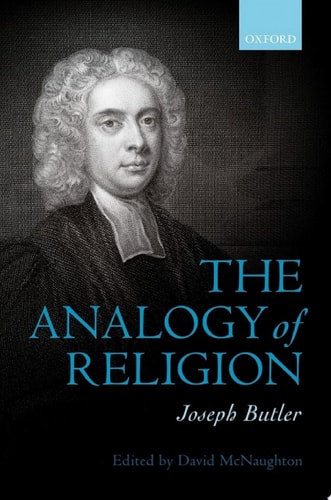
Joseph Butler: The Analogy of Religion
0
0
As an Amazon Associate and affiliate partner, Menrva Books earns from qualifying purchases. Learn more
Author Description
Joseph Butler's The Analogy of Religion (1736) is an important work in terms of its historical influence and its contemporary relevance. In it, Butler defends Christian belief against many well-known objections: for instance, that the evidence for Christianity is weak; that it is impossible to believe in miracles; that if God existed he would have revealed himself clearly to everyone. The problems Butler discusses are current in contemporary philosophy of religion, but his answers are often ignored, or given short shrift. Butler argues that by examining this world we have reason to believe its Creator is both benevolent and just; that virtue will be rewarded and vice punished. Even if we have doubts, we would be well advised to take Christianity seriously, given what is at stake. The work includes seminal discussions of life after death, personal identity, and the structure of our ethical thought. In addition to extensive notes, David McNaughton's edition includes a detailed synopsis, a selection from the correspondence between Butler and Samuel Clarke, and an oveview of philosophical influences on Butler's thought.
Menrva's Summary
THE THESIS
How can the principles of natural religion be used to defend the credibility of Christian revelation against the skepticism of the Enlightenment? Joseph Butler, an 18th-century Anglican bishop, constructs a systematic argument using the method of analogy to demonstrate that the difficulties found in Christian doctrine are parallel to the difficulties observed in the natural world. By establishing that the same Creator governs both realms, he posits that a rational person should accept the probability of Christian truth despite lingering intellectual doubts.
THE SCOPE MAP
What You Will Find
- A systematic defense of Christian belief against deist and skeptical objections.
- Arguments concerning the nature of personal identity and moral agency.
- Discussions on the existence of a benevolent and just Creator.
- Supplemental materials including correspondence with Samuel Clarke and historical context.
Scope Limits
- The text does not provide a modern scientific critique of the theological claims.
- It does not address non-Christian religious frameworks or secular humanism in a contemporary context.
THE AUTHORITY PERSPECTIVE
Scholars and philosophers recognize this work as a foundational text in the philosophy of religion, particularly for its rigorous application of probabilistic reasoning. Readers frequently note the academic density of the prose, which requires careful attention to 18th-century logical structures.
Page Count:
315
Publication Date:
2021-01-01
Publisher:
OUP Oxford
ISBN-10:
0191088919
ISBN-13:
9780191088919
Religion
Philosophy
18th century
Apologetics
Christian Theology
Ethics
Community Tags
Similar Books