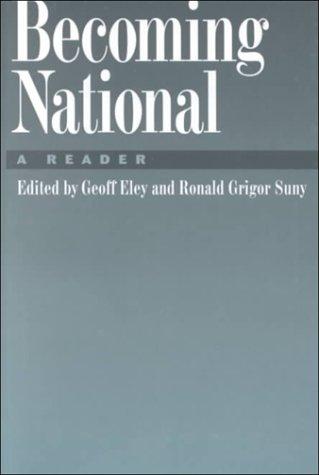
Becoming National
0
0
As an Amazon Associate and affiliate partner, Menrva Books earns from qualifying purchases. Learn more
Author Description
Being national is the condition of our times, yet never before has the idea of the nation been under such scrutiny. With the collapse of the bi-polar world of the Cold War, there has also been a parallel rise in the subnational - the claims of local, regional and ethnic minorities - economic globalization, American cultural hegemony, international migration, and diasporization. In Becoming National Geoff Eley and Ronald Grigor Suny, two of the foremost authorities on nationalism, acknowledge these changes by combining a diverse selection of readings with a unifying introduction and instructive headnotes that move the discussion of nationalism onto a new and contemporary level. Each group of readings is introduced by a brief historical essay, and the readings are fully annotated. Emphasizing the recent intellectual advances and influential ideas of Miroslav Hroch, Benedict Anderson, Paul Gilroy, Stuart Hall, Lauren Berlant and a host of others, this book underscores the nineteenth and twentieth century nationalist theories to show not only where scholars of nationalism have been but where they are going. Drawing on the strengths of recent cultural studies, including race and gender identities, the editors show that though politics is the ground upon which nationalism is constructed, culture is the terrain on which it is elaborated and fought over.
Menrva's Summary
THE THESIS
The concept of the nation is undergoing intense scrutiny in the post-Cold War era, challenged by resurgent subnational identities and globalizing forces. This book, edited by leading scholars Geoff Eley and Ronald Grigor Suny, explores the complexities of nationalism by presenting a curated selection of readings from influential thinkers like Miroslav Hroch, Benedict Anderson, and Stuart Hall. It aims to advance the contemporary discussion on nationalism by examining its historical development in the nineteenth and twentieth centuries and its cultural dimensions, including race and gender. The work posits that while politics forms the basis of nationalism, culture is the arena where it is ultimately shaped and contested.
THE SCOPE MAP
- A diverse selection of readings on nationalism from key intellectuals.
- Unifying introduction and instructive headnotes by the editors.
- Brief historical essays introducing each group of readings.
- Fully annotated readings for deeper understanding.
- Emphasis on recent intellectual advances and influential ideas in nationalism studies.
- Exploration of nationalism's construction through politics and its elaboration through culture.
- Consideration of race and gender identities within the context of nationalism.
THE AUTHORITY PERSPECTIVE
This collection is presented as a contemporary-level discussion on nationalism, drawing on recent intellectual advances and influential ideas from scholars across various fields. The editors emphasize the importance of cultural studies, including race and gender identities, in understanding how nationalism is constructed and contested. The book aims to guide readers through the historical development of nationalist theories and point towards future directions in the field. It is structured to provide a comprehensive overview for those studying the evolving concept of the nation.
Page Count:
518
Publication Date:
1996-01-01
ISBN-10:
0195096606
Non-Fiction
History
Nationalism
Community Tags
Similar Books