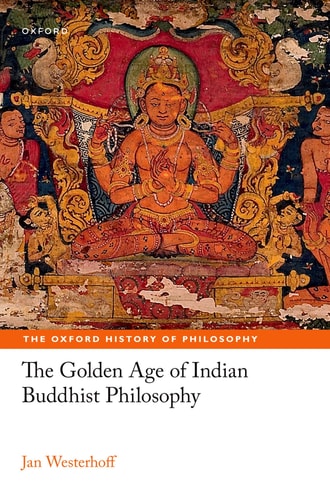
The Golden Age of Indian Buddhist Philosophy
0
0
As an Amazon Associate and affiliate partner, Menrva Books earns from qualifying purchases. Learn more
Author Description
Jan Westerhoff unfolds the story of one of the richest episodes in the history of Indian thought, the development of Buddhist philosophy in the first millennium CE. He starts from the composition of the Abhidharma works before the beginning of the common era and continues up to the time of Dharmakirti in the sixth century. This period was characterized by the development of a variety of philosophical schools and approaches that have shaped Buddhist thought up to the present day: the scholasticism of the Abhidharma, the Madhyamaka's theory of emptiness, Yogacara idealism, and the logical and epistemological works of Dinnaga and Dharmakirti. The book attempts to describe the historical development of these schools in their intellectual and cultural context, with particular emphasis on three factors that shaped the development of Buddhist philosophical thought: the need to spell out the contents of canonical texts, the discourses of the historical Buddha and the Mahayana sutras; the desire to defend their positions by sophisticated arguments against criticisms from fellow Buddhists and from non-Buddhist thinkers of classical Indian philosophy; and the need to account for insights gained through the application of specific meditative techniques. While the main focus is the period up to the sixth century CE, Westerhoff also discusses some important thinkers who influenced Buddhist thought between this time and the decline of Buddhist scholastic philosophy in India at the beginning of the thirteenth century. His aim is that the historical presentation will also allow the reader to get a better systematic grasp of key Buddhist concepts such as non-self, suffering, reincarnation, karma, and nirvana.
Menrva's Summary
THE THESIS
This book investigates the intellectual evolution of Buddhist philosophy in India during the first millennium CE, focusing on how specific schools and doctrines emerged and solidified. Jan Westerhoff, a scholar of Indian philosophy, utilizes a historical and systematic approach to map the development of Buddhist thought from the early Abhidharma works through the influential logical contributions of Dinnaga and Dharmakirti. The text argues that this philosophical maturation was driven by the necessity of interpreting canonical texts, the pressure of external and internal debate, and the integration of meditative insights into formal logical frameworks.
THE SCOPE MAP
What You Will Find
- A historical survey of Buddhist philosophical schools including Abhidharma, Madhyamaka, and Yogacara.
- An analysis of the intellectual and cultural contexts that influenced the development of key concepts like karma, non-self, and nirvana.
- A systematic examination of the argumentative strategies used by Buddhist thinkers to defend their positions against non-Buddhist critics.
- An exploration of the relationship between meditative practice and the formalization of philosophical doctrine.
THE AUTHORITY PERSPECTIVE
Experts recognize this work as a comprehensive and rigorous contribution to the study of classical Indian philosophy. Readers frequently note the academic density of the prose, which serves as a foundational resource for those seeking to understand the complex evolution of Buddhist scholasticism.
Page Count:
352
Publication Date:
2023-05-01
Publisher:
Oxford University Press
ISBN-10:
0198878397
ISBN-13:
9780198878391
Religion
Politics
Philosophy
History
Buddhism
Buddhist Philosophy
Buddhism india
New Used & Rental Textbooks
Eastern
History & Surveys
Community Tags
Other Editions(2)
Similar Books