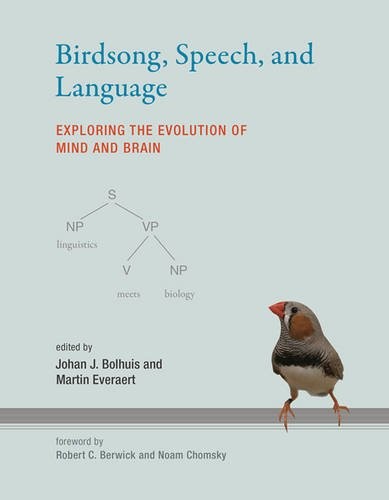
Birdsong, Speech, and Language
0
0
As an Amazon Associate and affiliate partner, Menrva Books earns from qualifying purchases. Learn more
Author Description
Scholars have long been captivated by the parallels between birdsong and human speech and language. In this book, leading scholars draw on the latest research to explore what birdsong can tell us about the biology of human speech and language and the consequences for evolutionary biology. They examine the cognitive and neural similarities between birdsong learning and speech and language acquisition, considering vocal imitation, auditory learning, an early vocalization phase ("babbling"), the structural properties of birdsong and human language, and the striking similarities between the neural organization of learning and vocal production in birdsong and human speech. After outlining the basic issues involved in the study of both language and evolution, the contributors compare birdsong and language in terms of acquisition, recursion, and core structural properties, and then examine the neurobiology of song and speech, genomic factors, and the emergence and evolution of language.
Menrva's Summary
THE THESIS
This book investigates the profound biological and evolutionary connections between birdsong and human speech and language. Leading scholars synthesize current research to explore how studying birdsong can illuminate the biological underpinnings of human language and its evolutionary trajectory. The contributors examine shared cognitive and neural mechanisms involved in vocal learning, including imitation, early vocalization phases, and the structural parallels between birdsong and human language.
THE SCOPE MAP
- Comparative analysis of birdsong learning and human speech acquisition.
- Examination of vocal imitation and auditory learning processes.
- Discussion of early vocalization phases, such as 'babbling' in both species.
- Exploration of structural similarities between birdsong and human language.
- Neurobiological comparisons of learning and vocal production.
- Analysis of genomic factors influencing vocal communication.
- Consideration of the emergence and evolution of language.
THE AUTHORITY PERSPECTIVE
This collection of essays offers a comprehensive overview of the current state of research into the parallels between birdsong and human language. The contributors, all leading scholars in their respective fields, provide detailed insights into the cognitive, neural, and evolutionary aspects of vocal communication. The book is structured to guide readers from foundational concepts to more complex analyses of neurobiology and genomics. It serves as a valuable resource for researchers and students interested in comparative cognition, linguistics, and evolutionary biology.
Page Count:
560
Publication Date:
2013-01-01
ISBN-10:
0262018608
ISBN-13:
9780262018609
Science
Non-Fiction
Evolutionary Biology
Linguistics
Neuroscience
Community Tags
Similar Books