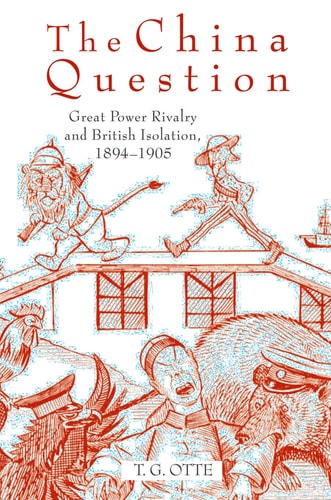
The China Question: Great Power Rivalry and British Isolation, 1894-1905
0
0
As an Amazon Associate and affiliate partner, Menrva Books earns from qualifying purchases. Learn more
Author Description
Between 1894 and 1905 the question of the Chinese Empire's future development, its survival even, was the most pressing overseas problem facing the Great Powers. The frantic 'scramble for Africa' and the often more intense drama of the 'Eastern Question' notwithstanding, it was the 'China Question' that had the most profound implications for the Powers.Since China's defeat in the 1894-5 war with Japan, the country's final disintegration was widely anticipated; and so was a wider Great Power conflict in the event of China's implosion. At times, that prospect seemed very real. The prospect of China's break-up and of large-scale international conflict in its wake altered the configuration among the Great Powers. Instability in the Far East had ramifications beyond the confines of the region; and, as this study shows, the events of 1894-5 initiated a wider transformation of international politics. No Power was more affected by these changes than Britain. The 'China Question', therefore, provides an ideal prism through which to view the problems of late nineteenth-century British world policy, and the policy of 'isolationism' in particular.This study breaks new ground by adopting a deliberately global approach in looking at British policy, emphasizing the connections between European and overseas developments, and by encompassing diplomatic, commercial, financial, and strategic factors as well as the politics of foreign policy.
Menrva's Summary
THE THESIS
How did the instability of the Chinese Empire between 1894 and 1905 force a fundamental shift in British foreign policy and its strategy of isolationism? T. G. Otte, a specialist in diplomatic history, utilizes a vast array of archival sources to examine the intersection of global power dynamics and the potential collapse of the Qing dynasty. The author argues that the 'China Question' served as the primary catalyst for Britain to re-evaluate its international standing, moving away from its traditional policy of isolation toward new strategic alignments. By integrating economic, military, and diplomatic data, the work provides a comprehensive analysis of how regional crises in the Far East dictated the broader trajectory of European imperial politics.
THE SCOPE MAP
What You Will Find
- Analysis of the geopolitical impact of the First Sino-Japanese War on global power structures.
- Examination of the transition from British isolationism to the formation of new international alliances.
- Integration of diplomatic, commercial, financial, and strategic factors influencing late nineteenth-century foreign policy.
- A global approach connecting European domestic politics with overseas imperial developments.
THE AUTHORITY PERSPECTIVE
Scholars and historians frequently cite this work as a definitive account of late Victorian and Edwardian diplomacy. Readers often note the high density of the prose and the meticulous use of primary source documentation to support the author's arguments.
Page Count:
352
Publication Date:
2007-05-31
Publisher:
Oxford University Press
ISBN-10:
0199211094
ISBN-13:
9780199211098
History
International relations
Asian History
Diplomatic History
British History
Community Tags
Similar Books