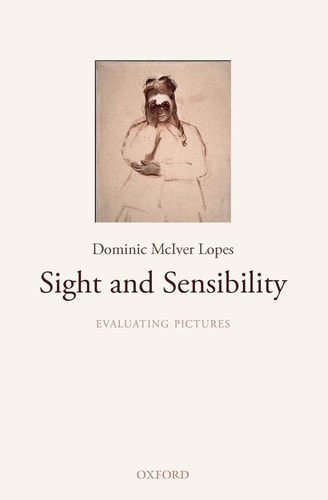
Sight and Sensibility: Evaluating Pictures
0
0
As an Amazon Associate and affiliate partner, Menrva Books earns from qualifying purchases. Learn more
Author Description
Looking at pictures, we see in them the scenes they depict, and any value they have springs from these experiences of seeing-in. Sight and Sensibility presents the first detailed and comprehensive theory of evaluating pictures. Dominic Lopes confronts the puzzle of how the value of seeing anything in a picture can exceed that of seeing it face to face--his solution pinpoints how seeing-in is like and unlike ordinary seeing. Moreover, since part of what we see in pictures is emotional expressions, his book also develops a theory of expression especially tailored to pictures.Not all evaluations of pictures as opportunities for seeing-in are aesthetic--others are cognitive or moral. Lopes argues that these evaluations interact, for some imply others. His argument entails novel conceptions of aesthetic and cognitive evaluation, such that aesthetic evaluation is distinguished from art evaluation as essentially tied to experience, and that cognitive evaluations assess cognitive capacities, including perceptual ones. Ultimately, Lopes defends images against the widespread criticism that they thwart serious thought, especially moral thought, because they merely replicate ordinary experience. He concludes by presenting detailed case studies of the contribution pictures can make to moral reflection.Sight and Sensibility will be essential reading for anyone working in aesthetics and art theory, and for all those intrigued by the power of images to affect our lives.
Menrva's Summary
THE THESIS
This book investigates the fundamental question of how we evaluate pictures and whether the experience of seeing-in can possess value that exceeds direct, face-to-face observation. Dominic McIver Lopes, a prominent philosopher of art, constructs a comprehensive theoretical framework that distinguishes between aesthetic, cognitive, and moral evaluations of imagery. By analyzing the mechanics of visual perception and emotional expression, Lopes argues that pictures serve as sophisticated tools for cognitive and moral reflection rather than mere replications of reality.
THE SCOPE MAP
What You Will Find
- A detailed theory of 'seeing-in' as a distinct perceptual experience.
- A specialized framework for understanding emotional expression within visual media.
- An analysis of the interaction between aesthetic, cognitive, and moral evaluative criteria.
- Case studies demonstrating the role of pictures in facilitating moral reasoning.
THE AUTHORITY PERSPECTIVE
Scholars in the field of aesthetics recognize this work as a rigorous contribution to the philosophy of art, particularly for its systematic approach to visual evaluation. Readers frequently note the academic density of the prose, which is tailored for those engaged in advanced art theory and philosophical discourse.
Page Count:
220
Publication Date:
2007-12-15
Publisher:
Clarendon Press
ISBN-10:
0199230447
ISBN-13:
9780199230440
Philosophy
Judgment
Aesthetics
Pictures
Art Criticism
Art Theory
Visual Arts
Community Tags
Similar Books