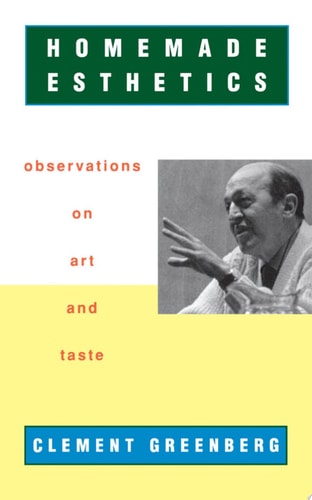
Homemade Esthetics: Observations on Art and Taste
0
0
As an Amazon Associate and affiliate partner, Menrva Books earns from qualifying purchases. Learn more
Author Description
Thanks to his unsurpassed eye and his fearless willingness to take a stand, Clement Greenberg (1909 1994) became one of the giants of 20th century art criticism a writer who set the terms of critical discourse from the moment he burst onto the scene with his seminal essays Avant Garde and Kitsch (1939) and Towards a Newer Laocoon (1940). In this work, which gathers previously uncollected essays and a series of seminars delivered at Bennington in 1971, Greenberg provides his most expansive statement of his views on taste and quality in art, arguing for an esthetic that flies in the face of current art world fashions. Greenberg insists despite the attempts from Marcel Duchamp onwards to escape the jurisdiction of taste by producing an art so disjunctive that it cannot be judged that taste is inexorable. He argues that standards of quality in art, the artist's responsibility to seek out the hardest demands of a medium, and the critic's responsibility to discriminate, are essential conditions for great art. The obsession with innovation the epidemic of newness leads, in Greenbergs view, to the boringness of so much avant garde art. He discusses the interplay of expectation and surprise in aesthetic experience, and the exalted consciousness produced by great art. Homemade Esthetics allows us particularly in the transcribed seminar sessions, never before published to watch the critics mind at work, defending (and at times reconsidering) his theories. His views, often controversial, are the record of a lifetime of looking at and thinking about art as intensely as anyone ever has.
Menrva's Summary
THE THESIS
Clement Greenberg investigates whether objective standards of quality and taste remain valid in the face of modern art's rejection of traditional aesthetic judgment. Greenberg, a prominent 20th-century art critic, draws upon decades of observation and his 1971 Bennington seminars to argue that art is fundamentally subject to the jurisdiction of taste. He posits that the artist's commitment to the specific demands of their medium and the critic's ability to discriminate are necessary for the creation of significant work, challenging the contemporary focus on novelty and disjunction.
THE SCOPE MAP
What You Will Find
- A collection of previously uncollected essays and transcribed seminar sessions.
- Analysis of the tension between aesthetic expectation and surprise.
- Critiques of the avant-garde movement's obsession with innovation.
- Theoretical frameworks regarding the role of the critic in evaluating quality.
Scope Limits
- The text does not provide a comprehensive history of 20th-century art movements.
- It does not address non-Western art traditions or contemporary digital media aesthetics.
THE AUTHORITY PERSPECTIVE
Critics and scholars recognize this work as a vital record of Greenberg's late-career intellectual development and his defense of formalist principles. Readers frequently note the academic density of the prose, which provides a direct look at the critic's rigorous, often uncompromising methodology.
Page Count:
249
Publication Date:
2000-01-01
Publisher:
Oxford University Press
ISBN-10:
0190286067
ISBN-13:
9780190286064
Non-Fiction
American Art
Art Criticism
Aesthetics
Humanities
Art Theory
Philosophy of
Community Tags
Other Editions(2)
Similar Books