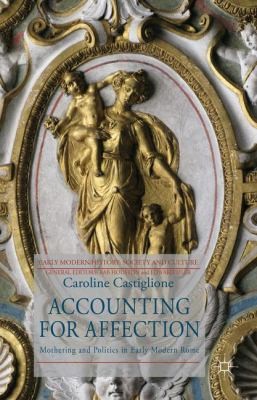
Accounting for Affection
0
0
As an Amazon Associate and affiliate partner, Menrva Books earns from qualifying purchases. Learn more
Author Description
Mothering in the western world has come to be viewed as a highly politicized activity. What mothers do (or fail to do) is publicly debated and considered a measure by which political ideologies are legitimated. While this is often thought to be a product of modernity, its roots and its consequences were already evident in early modern Rome, where an elective monarchy created a politically fluid situation in which aristocratic women played critical roles in advancing their families' interests. Accounting for Affection analyzes the symbiotic evolution of politics and mothering in Rome, where women did not hesitate to turn to the expanding judicial system during familial disputes. By examining women's legal activities, their letters, and their daily routines of caring for children, Caroline Castiglione recovers the connections between the political and the maternal. During family conflicts, a woman remained a family advocate (mater litigans) and the propagator of the dynasty of which she was a controversial part. Against the model of absolutist familial rule by men, aristocratic women proposed a consortium of interests model for the family. Such women praised the merits of love and raised maternal affection to the standard for all family members' behavior. From the religious controversies of their day, they crafted a domestic theology in which the wishes of all children had to be considered. Accounting for Affection illuminates the multifaceted nature of early modern motherhood, tracing the porous boundaries between the political, legal, religious, and medical activities of mothers in early modern Rome.
Menrva's Summary
THE THESIS
This book investigates the complex interplay between mothering and politics in early modern Rome, challenging the notion that the politicization of motherhood is a modern phenomenon. Caroline Castiglione examines how aristocratic women in Rome, operating within a politically fluid environment, leveraged their roles as mothers to advance family interests. The book analyzes their engagement with the judicial system, their personal correspondence, and their daily child-rearing practices to reveal the deep connections between the maternal and the political spheres. It argues that these women acted as family advocates and dynastic propagators, proposing a model of familial governance based on a consortium of interests rather than solely male absolutist rule.
THE SCOPE MAP
- Analysis of aristocratic women's legal activities in familial disputes.
- Examination of women's letters and daily routines related to child-rearing.
- Exploration of the concept of 'mater litigans' (litigating mother).
- Discussion of how women advanced dynastic interests through motherhood.
- Presentation of an alternative model for family governance: a consortium of interests.
- Investigation into the elevation of maternal affection as a behavioral standard.
- Analysis of the development of a 'domestic theology' considering children's wishes.
- Tracing the boundaries between political, legal, religious, and medical roles of mothers.
THE AUTHORITY PERSPECTIVE
The book is recognized for its detailed examination of early modern Roman society, specifically focusing on the agency of aristocratic women within the political landscape. It highlights how maternal roles were deeply intertwined with political maneuvering and family advancement, offering a nuanced perspective on the history of motherhood. The work is noted for its recovery of women's voices through legal records and personal correspondence, demonstrating their active participation in shaping familial and political structures. It contributes to a broader understanding of the historical roots of the politicization of mothering.
Page Count:
315
Publication Date:
2013-01-01
ISBN-10:
0230203310
ISBN-13:
9780230203310
History
Non-Fiction
Legal History
Social History
Family history
Community Tags
Similar Books