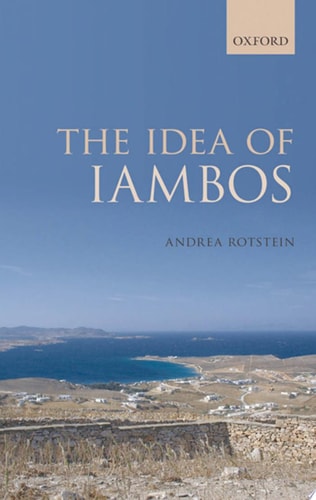
The Idea of Iambos
0
0
As an Amazon Associate and affiliate partner, Menrva Books earns from qualifying purchases. Learn more
Author Description
The Idea of Iambos is a long overdue study of the genre of Greek iambic poetry from the perspective provided by ancient testimonies. Andrea Rotstein places research on iambos in the framework of a new methodological approach to ancient genres based on the cognitive sciences, offering an unprecedented study of ancient theories of genres and the way they affected ancient scholarship. Rotstein also examines the possibility of musical performance of iambic poetry as well as the various occasions of public performance, particularly at musical contests and rhapsodic recitals. Finally, she argues that, from the Archaic to the Classical period, there was a shift from the notion of literary class depending primarily on rhythm and on its archetypical representative, Archilochus, towards iambos as a genre defined mainly by invective as its dominant feature.
Menrva's Summary
THE THESIS
This work investigates the evolution of the Greek iambic genre by analyzing ancient testimonies and applying a cognitive science framework to understand how ancient scholars conceptualized literary categories. Andrea Rotstein, a scholar of classical literature, synthesizes historical evidence and modern cognitive theory to challenge traditional views on how ancient genres were defined. She argues that the perception of iambos shifted significantly from the Archaic to the Classical period, moving from a focus on rhythmic structure to a definition centered on the function of invective. By examining the role of Archilochus and the context of public performance, the author provides a comprehensive re-evaluation of how these poems were categorized and understood by their original audiences.
THE SCOPE MAP
What You Will Find
- Analysis of ancient Greek iambic poetry through the lens of cognitive science and genre theory.
- Examination of the performance contexts of iambos, including musical contests and rhapsodic recitals.
- Investigation into the historical shift from rhythm-based definitions to invective-based definitions of the genre.
- Evaluation of the influence of the poet Archilochus on the scholarly perception of iambic literature.
THE AUTHORITY PERSPECTIVE
Scholars recognize this text as a significant contribution to the study of ancient genre theory and the reception of Greek poetry. Readers frequently note the academic density of the prose, which is intended for specialists in classical philology and literary history.
Page Count:
400
Publication Date:
2010-02-28
Publisher:
Oxford University Press
ISBN-10:
0199286272
ISBN-13:
9780199286270
History
Poetry
Ancient Greece
Greek language
Literary Criticism
Community Tags
Similar Books