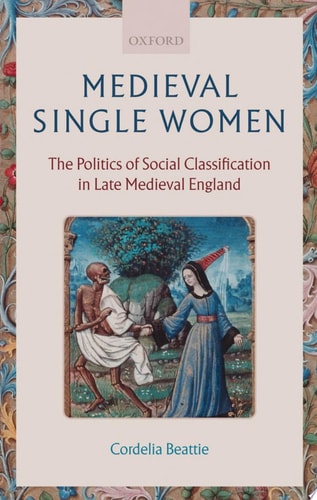
Medieval Single Women: The Politics of Social Classification in Late Medieval England
0
0
As an Amazon Associate and affiliate partner, Menrva Books earns from qualifying purchases. Learn more
Author Description
The single woman is a troubling and disruptive category. Does it denote all unmarried women, therefore creating a group which every female was part of at some stage in her life? Or, were the categories "maiden" and "widow" so culturally significant in late medieval England that "single woman" was a residual category for women seen as anomalous? Was the category "single man" used in an equivalent way and, if not, why? This study offers a way into the complex process of social classification in late medieval England.All societies use classifications in order to understand and impose order. In this book, Cordelia Beattie views classification as a political act, an act of power: those classifying must make choices about which divisions are most important or about who falls into which category, and such choices have repercussions. Defining how a group or an individual should be labelled, means variables such as social status, gender, or age, are prioritized. Rather than isolate gender as a variable, this book examines how it relates to other social cleavages. Using a variety of approaches, from social and cultural history, to gender history, and medieval studies, its original methodology offers an innovative approach to a range of historical texts, from pastoral manuals to tax returns, and guild registers.
Menrva's Summary
THE THESIS
This book investigates how the category of the single woman functioned as a political and social construct within the power structures of late medieval England. Cordelia Beattie, a scholar in medieval history, examines the intersection of gender, age, and social status to determine how medieval society categorized individuals. By analyzing the linguistic and administrative labels applied to women, the author argues that classification was not a neutral act but a deliberate exercise of authority that prioritized specific social hierarchies over others.
THE SCOPE MAP
What You Will Find
- Analysis of historical documents including pastoral manuals, tax returns, and guild registers.
- A methodological framework for interpreting social classification as a political act.
- Comparative study of gendered terminology such as 'maiden' and 'widow' versus 'single woman'.
- Examination of how social status and age variables interact with gendered labels.
THE AUTHORITY PERSPECTIVE
Scholars in the field of medieval history recognize this work as a significant contribution to the study of social taxonomy and gendered power dynamics. Readers frequently note the academic rigor and the innovative methodology used to interpret diverse primary source materials.
Page Count:
200
Publication Date:
2007-10-25
Publisher:
Oxford University Press
ISBN-10:
0199283419
ISBN-13:
9780199283415
History
Gender Studies
England
Women - Europe
Social History
Sex Role
Women
Cultural History
Single Women
Community Tags
Similar Books