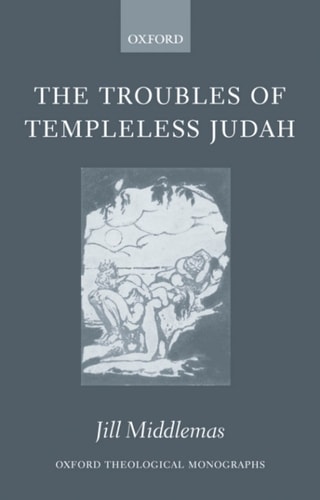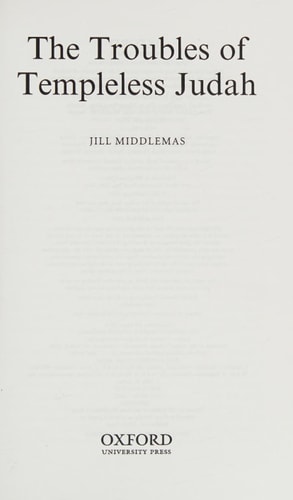
The Troubles of Templeless Judah
0
0
As an Amazon Associate and affiliate partner, Menrva Books earns from qualifying purchases. Learn more
Author Description
The time of the Babylonian capitivity (c.587-539 BCE) is of seminal importance for the formation of the Hebrew Bible as well as for the religious development of Judaism. Previous studies of this era have usually privileged the perspective of the community of captives (the Golah), and the period is known as the "Exilic Age." Jill Middlemas challenges this consensus, arguing that the Golah community represents only one viewpoint, and that the experiences and contributions of the majority of the Judaean population, those who remained in Judah, need to be more fully appreciated.
Menrva's Summary
THE THESIS
Does the traditional focus on the Babylonian exile obscure the religious and social realities of the Judaean population that remained in their homeland? Jill Middlemas, a scholar of Hebrew Bible and ancient Near Eastern history, examines the period between 587 and 539 BCE to challenge the long-standing academic consensus that prioritizes the Golah community's perspective. By analyzing archaeological evidence and biblical texts, she argues that the experiences of those left behind in Judah were equally critical to the development of early Judaism.
THE SCOPE MAP
What You Will Find
- Historical analysis of the Babylonian captivity period (c. 587-539 BCE).
- Critical evaluation of the 'Exilic Age' paradigm in biblical scholarship.
- Examination of the social and religious status of the non-exiled Judaean population.
- Synthesis of archaeological data and textual evidence from the Hebrew Bible.
THE AUTHORITY PERSPECTIVE
Scholars recognize this monograph as a significant contribution to the study of the exilic period, particularly for its corrective focus on the non-exiled population. Readers frequently note the academic density of the prose, making it a specialized resource for students and researchers in theology and ancient history.
Page Count:
306
Publication Date:
2005-12-08
Publisher:
Oxford University Press
ISBN-10:
0199283869
ISBN-13:
9780199283866
History
Religion
Theology
Judaism