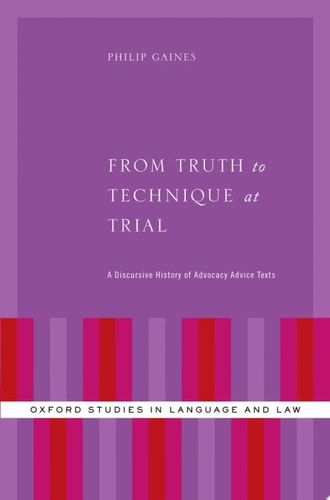
From Truth to Technique at Trial
0
0
As an Amazon Associate and affiliate partner, Menrva Books earns from qualifying purchases. Learn more
Author Description
From Truth To Technique addresses key questions raised by the burgeoning literature in what Philip Gaines calls advocacy advice texts-manuals, handbooks, and other how-to guides-written by lawyers for lawyers, both practicing and aspiring, to help them be as effective as possible in trial advocacy. In these texts, advice authors share principles, strategies, and techniques for persuading juries and winning cases. Some manuals even form the basis for required advocacy courses in law schools. Unlike training manuals in other professional domains-sales, leadership, management, fundraising, coaching, etc.-advocacy advice texts offer guidance for effectiveness in a realm of activity where the stakes may be the very highest for the parties and where society has an abiding interest in the truth being discovered and justice being done. Helping advocates learn how to win cases may be the ultimate purpose of advice texts, but to what extent are ideas about the values of truth and justice-what Gaines calls metavalues-incorporated into discussions about winning tactics and techniques? To explore this question, Gaines takes the reader through a discursive history of the relation between technique and metavalues as presented in advocacy advice-beginning with a thematic analysis of the first texts published in the Anglo-American tradition in the early 17th century, through treatises written during seasons of radical change in the profession in the 18th and 19th centuries, and up to the present day with a look at the more than 200 trial manuals currently in print. This diacronic study reveals dramatic changes in the place authors give to the metavalues of truth and justice when lawyers advise other lawyers about how to be effective in the courtroom.
Menrva's Summary
THE THESIS
This book investigates the extent to which the values of truth and justice are integrated into the tactical advice provided in trial advocacy manuals. Philip Gaines, an expert in legal discourse, examines the evolution of professional guidance for lawyers by analyzing the tension between winning strategies and the ethical obligations of the legal system. By evaluating the shift in rhetoric from the 17th century to the present, the author provides a framework for understanding how the legal profession balances pragmatic effectiveness with its foundational commitment to justice.
THE SCOPE MAP
What You Will Find
- A diachronic study of over 200 trial advocacy manuals spanning four centuries.
- A thematic analysis of the Anglo-American legal tradition from the 17th century to the modern era.
- An examination of 'metavalues'—specifically truth and justice—within the context of courtroom persuasion techniques.
- A comparative look at how legal training manuals differ from professional development literature in other fields like sales or management.
THE AUTHORITY PERSPECTIVE
Experts recognize this work as a significant contribution to the study of legal rhetoric and professional ethics. Readers frequently note the academic density of the prose, which serves as a foundational text for those interested in the history of trial advocacy and the evolution of legal training.
Page Count:
288
Publication Date:
2016-01-01
Publisher:
Oxford University Press
ISBN-10:
0199333610
ISBN-13:
9780199333615
History
Legal Studies
Law
Professional Development
Communication
Community Tags
Similar Books