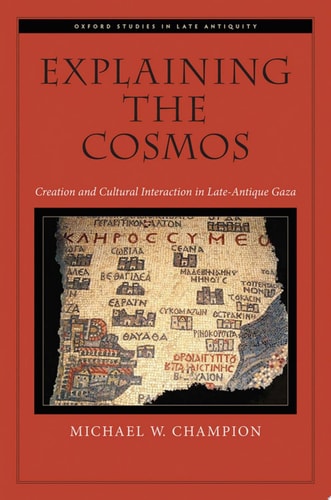
Explaining the Cosmos: Creation and Cultural Interaction in Late-Antique Gaza
0
0
As an Amazon Associate and affiliate partner, Menrva Books earns from qualifying purchases. Learn more
Author Description
Explaining the Cosmos analyzes the writings of three thinkers associated with Gaza: Aeneas, Zacharias and Procopius. Together, they offer a case study for the appropriation, adaptation, and transformation of classical philosophy in late antiquity, and for cultural transitions more generally in Gaza. Aeneas claimed that the "Academy and Lyceum" had been transferred to Gaza. This book asks what the cultural and intellectual characteristics of the Gazan "Academies" were, and how members of the schools mixed with local cultures of Christians, philosophers, rhetoricians and monks from the local monasteries. Aeneas, Zacharias and Procopius each contributed to debates about the creation and eternity of the world, which ran from the Neoplatonist Proclus into the sixth-century disputes between Philoponus, Simplicius and Cosmas Indicopleustes. The Gazan contribution is significant in its own right, highlighting distinctive aspects of late-antique Christianity, and it throws the later philosophical debates into sharper relief. Focusing on the creation debates also allows for exploration of the local cultures that constituted Gazan society in the late-fifth and early-sixth centuries. Explaining the Cosmos further explores cultural dynamics in the Gazan schools and monasteries and the wider cultural history of the city. The Gazans adapt and transform aspects of Classical and Neoplatonic culture while rejecting Neoplatonic religious claims. The study also analyses the Gazans' intellectual contributions in the context of Neoplatonism and early Christianity. The Gaza which emerges from this study is a set of cultures in transition, mutually constituting and transforming each other through a fugal pattern of exchange, adaptation, conflict and collaboration.
Menrva's Summary
THE THESIS
This book investigates how three prominent thinkers in late-antique Gaza—Aeneas, Zacharias, and Procopius—reconciled classical Neoplatonic philosophy with Christian theology during a period of significant cultural transition. Michael W. Champion, a scholar of late antiquity, utilizes the writings of these Gazan intellectuals to examine the intellectual climate of the region's schools and monasteries. By focusing on debates regarding the creation and eternity of the world, the author argues that these thinkers engaged in a complex process of appropriation and transformation of classical thought. The study provides a framework for understanding how local cultural dynamics in Gaza influenced broader philosophical disputes of the sixth century.
THE SCOPE MAP
What You Will Find
- An analysis of the intellectual contributions of Aeneas, Zacharias, and Procopius within the context of Neoplatonism and early Christianity.
- A detailed examination of the cultural and intellectual characteristics of the Gazan schools and their interaction with local monastic communities.
- A study of the creation debates that connected Gazan thinkers to figures such as Proclus, Philoponus, and Simplicius.
- An exploration of the social and religious dynamics of Gaza during the late-fifth and early-sixth centuries.
THE AUTHORITY PERSPECTIVE
Scholars and historians of late antiquity identify this work as a significant contribution to the study of regional intellectual history and the reception of classical philosophy in Christian contexts. Readers frequently note the academic density of the prose and the author's meticulous attention to the nuances of late-antique theological and philosophical discourse.
Page Count:
256
Publication Date:
2013-01-01
Publisher:
Oxford University Press
ISBN-10:
0199337497
ISBN-13:
9780199337491
History
Philosophy
Religion
Late Antiquity
History & Surveys
Middle East
Creation
Ancient History
Christianity
Community Tags
Other Editions(2)

Similar Books






Reader Comments
Share Your Thoughts
No comments yet. Be the first to share your thoughts!